
• About Curate Mike
  • Wandering Wonderings

curacy

~ thoughts from the desert

curacy

Tag Archives: God

Social Justice and The Great Divide

18 Tuesday Aug 2020

Posted by CurateMike in Social Justice

≈ Leave a comment

Tags

Capitalism, Church, God, Holy spirit, Jesus, Oppportunity, Outcome, Social Justice, Socialism, Trinity

It seems like a trivially obvious observation to say that the US is a country divided.  Politics, religion, entertainment, racial issues, sports, poverty, fashion, taxation…and, of course, face masks…everywhere one turns there seems opportunity to express our disagreement with another.

For the purposes of this post, I am interested in the divide over social justice: how we treat others.  I want to think about the division at the national policy level and at the personal level.

I came across an interesting way to think of our division in the approach to social justice in Timothy Patitsas’ recent book, The Ethics of Beauty.  Patitsas claims that in the “old world” (pre-Enlightment period) it was widely accepted that there were two, competing methods of approaching social justice.

First, there is the “you get what you fairly deserve,” pull yourself up by our own bootstraps, meaning.  This is the equal opportunity meaning: everyone has the chance to make it, so what you fairly get in life is directly related to what you make of your opportunity.  This might be considered pure capitalism.

The second meaning is that the benefits and rewards of society should be distributed fairly among all, that “no one is left behind.”  This is the equal outcome meaning: everyone should fairly receive in the distribution of societal benefits and rewards based on needs regardless of their effort.  This might be considered pure socialism.

The first meaning, equal opportunity, is in fact built into the DNA of the USA.  Our Declaration of Independence says people are created equal and each has the unalienable right of liberty and the pursuit of happiness.  After all, the American narrative is that we are the land of the free where everyone has the opportunity to make it, to achieve the “American Dream.”

Yet, the Statue of Liberty says something about equal outcome, and that is also part of the DNA of the USA:

Give me your tired, your poor, Your huddled masses yearning to breathe free, The wretched refuse of your teeming shore. Send these, the homeless, tempest-tossed to me, I lift my lamp beside the golden door!

The implication of this is that we are a country that throws open our borders and freely shares what we have with the less fortunate.

In reality, the ideal of “equal opportunity is just that, an ideal.  Philosophers talk of something called “moral luck.”  Whether we are born with physical or mental challenges, make decisions that turn out poorly,  born to bad parents, or are struck down by “accidents,” these are the kinds of things that effect our lives that are simply beyond our control.  This is what is meant by moral luck.  It is these things we refer to as our “baggage,” and we all have baggage!

So, we need both methods…each of us must pull our own weight as we can while realizing that because of moral luck all of us need some help and some of us will always need help.

Patitsas, drawing on the work of a number of other scholars, notes that these two conflicting methods of social justice have existed throughout human civilization.  Some of us are drawn to one method or the other and many of us are somewhere along the continuum between the two extremes.  While there can seem like an insurmountable divide between these two competing methods, in truth, both are needed.  Extreme “equal opportunity” is heartless and cruel.  Extreme “equal outcome” is mindless and enabling.

Throughout history a third, mediating force was sometimes present to bring these two competing views into balance: the Christian Church bringing the love of Christ.  At its historical best, the State and the Church worked together (e.g., symphonia in the Byzantine Empire) to let the love of Christ balance equal opportunity with equal outcome to approach Christ-like social justice.

At the national policy-making level in the USA, we have separated Church and State.  We have strayed from the intent of the country’s founders and moved away from a Judeo-Christian based value system (Oz Guinness, A Free People’s Suicide).  Hence, there is no third way readily available to help us find balance in our approach to social justice; rather, we are left with only a power based approach focused primarily on the either/or of equal opportunity and equal outcome.

Governments and Churches can seem like big, impersonal institutions.   Trying to solve the nation problem of unjust social justice can seem overwhelming.  National policies, while often necessary, are sweeping scope and take their aim at humanity rather than at individual humans.  So, I want to look at social justice from a personal perspective.

Join me in a “thought experiment”:  I am walking in the city and I come across a homeless person asking for money.  This person seems mostly like your average, normal, healthy person, just dirty and asking for money.  I notice they are standing near a storefront with a help wanted sign in the window.  What will I do?  I wonder to myself, “Do they really need a helping hand (equal outcome) or do they simply not want to work (equal opportunity)?”  The internal debate begins: Should I give them some money?  Should I exercise “tough love” and point at the storefront sign and say, “get a job”?  I am at war within myself.  I need the same third mediating force: the love of Christ.

There is no one-size-fits-all response to homeless people, to continue this example, even with public policy.  Here are two biblical stories to make my point.  In the first story, a woman is caught in adultery by Jewish leaders and brought to Jesus with the expectation that He will condemn her to death by stoning (John 8:1-11).  Note that the man was not brought to Jesus, only the woman.  Jesus first turns the table on her accusers and says, “Let the one of you with no sin throw the first stone at her.”  When the accusers sheepishly leave, Jesus turns to the woman and says, “Go and sin no more.”  That’s all He says.  He doesn’t offer her counseling, or console her over the injustice of the man being unaccused, or even give her a sympathetic shoulder.  No, He gives her an impossible command: “Go and sin no more” and sends her away. That is very tough love.

In the second story, Jesus meets a woman who in the heat of the day has come to the local well to get water (John 4:1-42).  She has two culturally shameful things against her: She is a Samaritan, a second class citizen in Jewish society; and she has been married five times and is now living with a guy, which is why she is getting water in the heat of the day…even her fellow Samaritan’s don’t want to have anything to do with her.  To her, Jesus speaks very kindly and offers her the path to eternal life; further, he tells her explicitly who He is (God!), which He rarely did with anyone.

Two women, both in the wrong, and both given very different responses from Jesus.  Because He is God (all knowing and loving), we must assume His responses were designed exactly to bring about the best for each woman.  There are many similar stories in the Bible…one answer to social justice clearly does not fit all circumstances. 

These stories of Jesus remind me of the great golf teacher, Harvey Penick.  He was a master at teaching someone the game of golf, not because he molded his students into a one-size-fits-all approach to golf, but because he saw and taught each student as an individual.  As evidence, he would not let another golfer observe the lesson he gave a student because what he told the student was designed exactly for them and no other.  He worried that the observer would take instruction not meant for them and try to apply it tho their game.  Penick, like Jesus in the stories above, told each person exactly what they individually needed to hear.

It is so easy for us to use the Bible or the sayings of the early church fathers or writings of saints to find a one-size-fits-all answer in the application of our approach to social justice.  However, to balance the right solutions between equal opportunity and equal outcome to the current problems of social justice requires that we see others around us as individual persons, not just as faceless “humanity.

Jesus walked everywhere.  He moved at 3 miles per hour, which means he saw the person in front of him.  Each of us needs to slow down and see the person in front of us, our “neighbor,” and to love them as Jesus does.  Me, one-on-one with you—there is no male or female, black or white, Republican or Democrat, conservative or liberal or progressive—rather, there is only you and me, each made in the image of God and infinitely precious to Him.  But, to love you as God loves you means I have to love God and draw ever nearer to Him in a loving relationship.  Only in this way can I begin to love you like Christ does and offer you social justice as God would.

Drawing ever closer toward oneness with Jesus is the divine goal for humankind (John 17:3, 25-26; 2Peter 1:4).  It was Jesus’ goal for the two women.  We should want it for ourselves and for each other.  This is real social justice.  Oneness with God is what the Church calls, theosis.

So, my best response to the current problems of unjust social justice is to begin with me.  I must draw closer to Jesus.  If I do otherwise, then I only add to the problems in the world.  St. Seraphim of Sarov said, “Aquire the Spirit of Peace (Holy Spirit) and a thousand around you will be saved.”  Only by my putting forth some effort and myreceivingthe undeserved kindness of God can I acquire His Spirit.  And only then can I begin to see you and to respond to you, my neighbor, and to love you as an individual just as Jesus loves both of us.  God’s love is the only way to mediate between equal opportunity and equal outcome.

In reality there is no great divide on the issue of social justice, there is only the love of God for all of us.
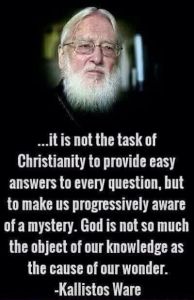

Questions for God (and it is my right to have answers)

31 Friday Jul 2020

Posted by CurateMike in All, Healing, Journey

≈ 2 Comments

Tags

Answers, God, Healing, Holy spirit, Jesus, Questions, Trauma

It seems as though the virus has given rise to many new questions.  So, I’ve been thinking a lot about questions…and answers.

QuoteMaster.org

There are new, virus-related questions, of course: When can we get back to normal life? Will a vaccine be forthcoming? Are masks effective? What will life be like post pandemic?  Somebody answer me!

Sometimes the questions are more urgent: How will I pay my rent?  Where will my next meal come from?  When can I visit my hospitalized loved one?  Somebody answer me!

And then there are really big questions, such as: What does it mean to be human?  Why am I here?  How can there be a good God who would allow such worldly horror?  Somebody answer me!

About my own questions, I remember saying years ago, When I get to Heaven I will have a lot of questions for God.  I said it with humor, but if I am honest I had the sincere expectation that God would submit to my demand once I stood face-to-face with him…and what I really meant was, God, you’ve got some explaining to do, and I‘m willing to listen to Your side before I judge You.

About questioning God, the curious thing for me is this: there is a written, historical record of quite a number of people who actually got to ask questions of God!  In the biblical Gospel accounts (Matthew, Mark, Luke, John) of Jesus, who is the God-man, when He walked the earth, people did ask Him  questions, and quite a lot of them according to Martin B. Copenhaver (Jesus is the Question).  During three-year period covered in the Gospels, the four writers record that people asked Jesus 183 questions.  He answered only 3.  ONLY 3! Worse yet, Jesus asked the people 307 questions.  

Yikes!…the thought of being questioned by God brings back my old “test anxiety” in a big way.  Seriously, though, the Gospel accounts seem to squash my idea of putting my most pressing questions to God and expecting answers.

Yet, does that mean I should have no questions for God?  Am I supposed to just have some sort of mindless “faith” in Him, afraid to ask anything for fear that He will turn the tables on me?

Here is a story.  In the Bible’s Old Testament, there was a wealthy family man named Job (rhymes with “robe”).  He had a wife, ten kids, and owned a very large ranch with thousands of head of livestock.  And, he was one of God’s favorite people.  In a single, tragic day rustlers stole all of his livestock and killed many of his herdsmen, and then a wind storm collapsed the house of one of his children killing all ten of them.  If that weren’t enough, Job himself was infected with painful boils.  In the days and weeks that followed, and as the shock of his loss began to wear off, Job had questions for God.  In page after page of the story, Job defends himself from friends who accuse him of having offended God and thus reaping due punishment.  Job continued to claim his innocence and began to insist in asking why this had happened to him.

Eventually, God appears before Job, but not to defend Himself from or explain Himself to Job.  You see, before Job can even open his mouth with his first question, God says, I will question you and you shall answer Me.  Then, like machine gun fire, God rattles off 67 questions for Job.  Questions like:

Where were you when I laid the foundations of the earth? Tell Me, if you have understanding. Who determined its measurements? Surely you know. Or who stretched the line upon it? To what were its foundations fastened, Or who laid its cornerstone, When the stars were made And all My angels praised Me in a loud voice?

On it goes.  Questions interspersed with sarcasm and facts.  I image Job cowering before God like Dorothy before the Wizard of Oz.

When God stops talking, Job has a sudden realization…I regard myself as dust and ashes, he says to God, please teach me.  Job’s questions are gone and he is beginning to be healed of his trauma.

But, how can he have such a rapid change of heart after enduring such trauma?  How could 67 questions bring that about?

Honestly, for a long while Job’s response struck me as remarkable to the point of incredulity. Had God simply responded to my questions with 67 of His own, I would have felt like I had been slapped down by a Bully.  My questions would metastasize into deep resentment toward or even hatred of God.  After all, I would silently rage, I didn’t ask to be born!  I didn’t ask for any of this!  I am tired of the unending battle against myself!  I am tired of living in this world!

Humanity’s questions are manifold and legitimate, they echo in the ears of my soul: Why was I…born into slavery, thrust into the horror of war, abused as a child, abused as a woman, subjected to repressive discrimination, falsely accused,?  Why did I…lose a child, lose a spouse, get this disease, have my dreams dashed, lose my life savings, become addicted, endure mental illness, lose my job, lose my home?  Why am I…so lonely, such a misfit, bullied, too different, trapped in a bad marriage, trapped in a dead-end job?  

More questions: Why did you bring me into this world, God?!  If you are everywhere and are all knowing, all powerful, and all loving, then why don’t you rescue me and fix this stupid world and those in it?!

Whether screaming, in laughter, in normal conversation tones, or in whispered weariness I have asked my own questions of God. 

Why, God?  It is the ultimate question.  I have come to know it is also a prayer.

So, how do I get to the point of beginning the healing that Job experienced? 

The late Catholic priest and writer Henry Nouwen (Spiritual Formation: Wisdom for the Long Walk of Faith) says this of our questions for God:

More often, as our questions and issues are tested and mature in [our] solitude [with God], the questions simply dissolve…God does not solve [all] our problems or answer all our questions, but [he] leads us closer to the mystery of our own existence where all questions cease. 

So, is that it?  Should I expect my questions to simply dissolve away with time and maturity as Nouwen suggests?  What about the hardship or trauma I may have experienced in this life that caused the questions…will that also simply dissolve, too?  No, something else must have happened to Job in his encounter with God to find the kind of contentment he confesses.

Back to Job’s story.  After God ends the questioning, Job says:

I have heard of You by the hearing of the ear, but now my eye sees You.

Job says he had heard of God.  That does not help me.  Who among us hasn’t heard of God.  But, what was different here is that Job also saw God.  Christian Orthodox tradition says that Job saw Christ Jesus.  Did he see the transfigured Jesus whose face shone like the sun? Or did he see the crucified Jesus hanging on the cross bearing Job’s pain and sin and the sin and pain of the world?  Whichever Jesus Job saw…God revealed Himself in the way Job needed to see so his questions would dissolve and he would began to be healed from the trauma.

In their encounter, God certainly gave Job truth: 67 questions and many statements of truth of who He is as God.  But, it wasn’t the hearing truth—God beating him about the head and shoulders with questions sarcasm—that dissolved Job’s questions and began his healing; rather, it was Job seeing the Beauty of God (Jesus) that helped him.  Truth by itself is like a sword that cuts us apart; only seeing Beauty—seeing God—can start us on the path of healing (Timothy G. Patatsis, The Ethics of Beauty).  Falling in love with God then becomes the path along which we journey to be healed.  

How do we see God like Job did?  He is all around us.  He may reveal Himself in a direct vision as He did with Job, the apostle Paul, and many, many others.  He may be seen as the Artist while sitting on that mountain top overlooking a scene that is too breathtaking to describe.  He may be seen as the crucified Christ in the healthcare worker sacrificing their safety during the pandemic.  He may be seen as the resurrected Jesus in the kindness of a friend who comforts.  He may be seen as the humble Jesus in the poor or in a visit to someone in prison.  He is all around us.

So, don’t be afraid of asking God questions.  Jesus was always gentle with honest questioners.  

The journey to dissolved questions is the journey of falling evermore deeply in love with God.  It is a matter for another time.  For now, be watchful.  Look for Beauty.  Look for God.

The Music of God

20 Saturday May 2017

Posted by CurateMike in All, Journey

≈ 2 Comments

Tags

Christianity, Church, God, Life, music, orthodoxy, poetry, religion, spirituality

Inspired by the metaphor of another writer…

MusicWhen I first heard the music of God, I was tone deaf.  Later in life, circumstances caused me to listen again.  This time, something in the music caught my ear…I continued listening.  Once I finally gave myself over to it, I was captivated by its beauty, goodness, and truth.  It spoke to the depths of my soul in a way that only music can.  I played it over and over.  I began to study the sheet music and to sing along.  I longed for others to hear it, to sing, too.

After awhile, I became a Pastor so that I might help others hear for the first time or to hear more deeply.

One day, I noticed a note out of place.  It was a small thing, one note in a grand score, but there it was.  Then, I began to hear other wrong notes. And, parts of the arrangement itself seemed somehow off.  I was becoming aware of the very faint echo of a more complete orchestration playing in my soul.

I sought silence in my life to try to hear more clearly what was so faint within.  The occasional mis-played note and the sections of poor arrangement were becoming an irritant in the music I once loved.  How could this be?

I joined with a group of pastors who were studying the Catholic mystics.  The music was set aright; beauty, goodness, and truth returned.  But over time, the music that continued to play within grew louder and more distinct.  The music I was hearing with my pastor friends was still off in some way I did not understand…it did not harmonize with the music within.  What I did know, however, was that I could no longer be content with the music surrounding me, I had to hear the music within.

When I first attended a Christian Orthodox Church, I knew immediately that I was hearing the music I was longing to hear, the music that had once been so faint within me.  I’ve been listening to it for several years now, letting it wash over me and permeate my heart and mind.  Slowly, I am hearing nuances previously unnoticed.  I try to hum along, but my voice seems croaked in comparison to the glory of the music.  I look forward to the day when I might sing along with the voices of the angels and the saints.  I have a long way to go.

It has been said that God is unknowable, but you have to know Him to know that.  This is the fundamental Christian paradox.

To know an unknowable God, to learn to sing along with the fullness of the music of God, to fully partake of the divine nature of the Source of the music…that will take an eternity.

Come and see…and hear the music.

The Way of Christ: Bearing a Little Shame and Finding Christ’s Joy

07 Wednesday Oct 2015

Posted by CurateMike in All, Journey

≈ 3 Comments

Tags

God, Humiliation, Jesus, Shame

Wretched man that I am! Who will save me from this body of death?
–St Paul

I have been on this earth for 6 decades. I just experienced a recent job change and move to a new state—another wearying “new beginning.” It caused me to reflect deeply on my life over the period of many months. In times of past reflection, I have always remembered the things I have accomplished and the adventures I have had. The nature of this change caused me to reflect on the person that I am. Images began to come into my mind, images would not stop—and they linger still—faces of the people I have hurt in no small way because of my radical self-centeredness. Some names I know, some I no longer remember or never knew. The overriding image in my mind is that of my life as a boat moving through a narrow canal, the wake of my life swamping all who are near the shore.

It is a remarkably painful image, that boat. During some late nights I wonder how I can continue to bear it. I see faces from my past as the waves of my life roll over them. I want to beg them for forgiveness. I have deeply hurt these people.. I want to hide myself from the world. I feel so deeply guilty for what I have done, but the guilt is familiar. What is new to me is that I have begun to feel deeply, deeply ashamed of who I am: a wretched man.

Jesus ‘…endured the cross, despising the shame…’

St. Paul says that Jesus “…endured the cross, despising the shame…” (Hebrews 12:1-3). Jesus unjustly endured the humiliation and shame of a criminal’s death, which He didn’t deserve. The Way of Christ for me, therefore, is the way of bearing the shame of who I am: a distorted human who deserves the cross of death and eternity in hell…and I must admit that fact to the God whom I love. It is the shame that I deserve and the cross of pain I must bear daily. And it puts me in the Way of Jesus, the path of salvation.

But, bearing my cross is not living a life of despair, or so I am learning. In the midst of the pain of my shame before God, a curious thing is beginning to happen. A very tiny point of light is appearing amidst the grayness of my shame. When I allow it to do so, that tiniest pinpoint of light illuminates those around me in such a way that I cannot help but love them and pray for them; they are me and I am them. Words fail to explain this mystery; perhaps the prayer of St. Nikolai Velimirovic will help: “For all the history of mankind from Adam to me, I repent; for all history is in my blood. For I am in Adam and Adam is in me.”

Most importantly, in my deep shame and pain I am finding budding joy. Jesus, “…for the JOY set before Him endured the cross, despising the shame…” Joy, the same joy of Christ given to you by Him (John 15:11) comes to you only through bearing your cross of shame and pain. The joy of Christ out of the pain of my cross. It is a mystery to me.

This is the Way of Jesus. You must face yourself and bear the pain of shame for your wretchedness to experience the joy of Christ. Four considerations:

  • Shame can be painful beyond your capacity to bear it. Pray that the Spirit will reveal to you the things about which you must feel shame. Do not simply reflect on your own life judging yourself by your standards. This is false shame.
  • Do not run from the shame God reveals to you. It may feel like it is beyond your capacity to bear, but it is not. Pray for tears of repentance. God is with you, weeping, too, and in answer to St. Paul’s question, above, God, through Jesus, will save you from your wretchedness.
  • Pray for a very wise, mature Christian man or woman—a spiritual father or mother—with whom you can share your shame…someone who will not try to “fix” you; rather, someone who will silently bear witness to your confession of shame before God.
  • Bear only a little of your shame. How much shame should you bear before God? St. Silouan, about whom I wrote last time, put it his way: “Stand at the brink of the abyss of despair, and when you see that you cannot bear it any more, draw back a little and have a cup of tea.”

In your bearing of your cross of the pain of your shame you will begin to experience the promised fullness of the joy that is Christ’s. This is the Way of Jesus. It is mysterious, indeed.

The Way of Christ–Descent into Humility

21 Monday Sep 2015

Posted by CurateMike in All, Heaven and Hell

≈ 4 Comments

Tags

Christ, God, Journey

If anyone is still out there following this blog…a friend of mine asked me to say a few words on his blog, which I have gladly done.

You can find my meager contribution here:

The Uncommon Journey

I may periodically post to his blog site, and I will let you know when I have done so.  I encourage you to visit this other site and to subscribe to Keith’s blog.

Christ is in our midst.

Journey Into Humility

09 Friday Jan 2015

Posted by CurateMike in All, Life

≈ 3 Comments

Tags

God, Humility, Jesus, Repentance

Let this mind be in you which was also in Christ Jesus, who, being in the form of God, did not consider it robbery to be equal with God, but made Himself of no reputation, taking the form of a bondservant, and coming in the likeness of men. And being found in appearance as a man, He humbled Himself and became obedient to the point of death, even the death of the cross. -Apostle Paul, Philippians 2:5-8

I know a man, once at the top of his profession.  He has a long list of credentials. He travelled the world as a representative of the world’s largest company in his industry. He worked with other companies and governments on matters of international regulation.  At times he had individual’s lives in his hands.  Now, he works in what most consider as an entry level job in his profession.

I know a woman, considered an expert in her field.  She held a prominent position in one of the largest organizations of its kind in the world.  She knows state and federal law applicable to her field.  She has spoken at national conventions and has consulted across the country. She has coached and influenced the lives of hundreds.  Now it is hard for her to be accepted into an occasional volunteer position in her field.

I know a man, once a spiritual leader of hundreds, ordained by his denomination.  He has years of advanced study behind him.  He has taught at the university level and led spiritual retreats across the country.  He now attends a beginners class with other new believers in his own faith.

Humility is a curious thing.  Someone once said that the moment we think we are humble we have lost it.  We often think of a humble person as one who does not seek to be noticed and if noticed is quick to deflect praise and give credit to another.  The humble person might say, “I didn’t do anything special,” or “I didn’t do anything anyone else would’t have done,” or “I didn’t really contribute anything, Jane did much more than I did.”

I think this is humility, but that it is so much more.

Let’s go a little deeper and consider cleaning toilets.  I have cleaned toilets for Christ.  In my zeal to help another, I have cleaned toilets on occasion.  And I have come to see the pride in that: “Look at me, everyone, I am such a good Christian that I clean toilets.”  There is no humility in that attitude!  But, what if the only job you could get is cleaning toilets?  What if, despite all of your years of schooling, your vast experience and expertise, your accumulated wisdom, etc., what if all anyone would hire you to do is to clean toilets?  This is a different level of humility.  Would you take the job or would you consider it beneath you?  If you took the job, would you do it daily as though you were doing it for God?

Deeper.  Imagine a private screening of your life story, but you see your actions through the eyes of others.    You see and hear the real story behind the story, how hurtful your actions have been, how self-centered your life really is…the lasting pain you have caused another.  My first response would be to quickly look around to ensure no one else was watching my movie.  Could you stand to watch as the all scenes unfolded or would you hide your eyes during the painful moments and relish the joyful ones?  Would you have the courage to not rationalize away all that you saw, but to face who you are?

Still deeper.  Think of what it would be like to reveal to another human the darkest side of yourself through the stories of the deeds and thoughts you have just witnessed.  Facing the shame of who we are is hard enough in the privacy of our own minds; however, would you have the courage to reveal it to another?  Not just to reveal the things you could bear revealing, but to reveal the deepest, darkest part of you?  What would it do to us?  Would we feel crushed?    Or…would we feel sorrow in the depths of our soul?

It is here, I believe, that humility and repentance become one.

But this is the one to whom I [God] will look: he who is humble and contrite in spirit and trembles at My word.

The sacrifices of God are a broken spirit, a broken and a contrite heart— These, O God, You will not despise.

True humility is an emptiness of self so that one can turn to and be filled with God (repentance).  It is realizing that we are nothing but dust with the life-giving breath of the Holy Spirit in us making us into the image of God Himself.  It is realizing that, as dust, we cannot even fully grasp the fulness of our own wretchedness.  However, it is not, ultimately, self-abuse.

St Gregory of Sanai says it well:

…true humility does not say humble words, nor does it assume humble looks, it does not force oneself either to think humbly of oneself, or to abuse oneself in self-belittlement. Although all such things are the beginning, the manifestations and the various aspects of humility, humility itself is grace, given from above. There are two kinds of humility, as the holy fathers teach: to deem oneself the lowest of all beings and to ascribe to God all one’s good actions. The first is the beginning, the second the end.

Image and Likeness

08 Monday Sep 2014

Posted by CurateMike in All, Humankind

≈ 1 Comment

Tags

Divine Dance, God, Holy spirit, image of God, Jesus, likeness of God, Theosis

Then God said, “Let Us make man in Our image, according to Our likeness…”
From the story of creation, Genesis 1:26

I’m sitting in a small beach house on the Gulf of Mexico and calling it work. Really, I am working…you will have to trust me on that. It is just that right now the work involves waiting on a client.

While I’m waiting I have these few minutes to enjoy God’s creation and to ponder what it means that we are made in God’s image and likeness.

Some biblical commentators have suggested that image and likeness are the same, that the writer of Genesis says the same thing twice and in two different ways to make the strong point of our value as humans.

I recently came across another explanation that I find more theologically satisfying.

“In the beginning…” as the Book says, God and the first humans were united; humankind was by Grace what God is by nature. All was “good” until our first parents fell for a lie. The consequence of their disobedience of God changed humanity; our respective natures, God’s and man’s, were no longer united. Without God’s Spirit within us we became bound to the dust out of which we were created rather than bound to our Creator. To speak like the late Carl Sagan, we became the stuff of the creation rather than the stuff of the Creator.

God’s words from Genesis 3:16–

For dust you are, and to dust you shall return.

Our union with God now broken, there was no way for us to remain in the Garden of Eden, the garden of perfect harmony with our Creator. We had to leave. It remained that way for us for untold years, and, left to our own devices, there was no way to return, no way to reunite human nature with Divine nature. Separation of our nature from God’s, and being nothing but dust, would have been our eternal fate had God chosen not to act on our behalf.

At the moment of our separation from Him he announced that He had a plan for our restoration to Him, a plan to rescue us from being bound to the dust which is the world. Then one day, over two thousand years ago, Jesus was born and God’s rescue operation was made evident in the person of a baby.

One of the central beliefs of Christianity is that Jesus was both God and man, both human and Divine. I think we so often focus on Jesus’ death that we forget the significance of His birth. At the moment of His conception and manifest in His birth, human nature and Divine nature were reunited. Jesus became, as the Bible tells us, the second Adam. This has the most profound implication for us! Because of His birth it became possible for each of us to be reunited with God. With the birth of Jesus, the potential now existed for us to return home.

This potential is how the early Church Fathers came to understand our being made in the “image” of God: it is the potential for our “sanctification,” for our two natures, God’s and ours, to be united (called Theosis). And it is this potential that gives us value as humans over any other living thing: we are created in the image of God. Each of us humans has the potential to have our individual nature united with God’s nature. There are some who would try to confer “personhood” on apes or dolphins or other creatures based on intelligence, language use, etc.; however, no other creature has the potential to be united with God; humans alone are created in the image of God.

With this understanding of “image,” here is a great quote from the late Archbishop Dimitri of Dallas I want to throw in at this point:

The greatest danger in the modern world is the attack on man as the image of God. That God became man in order to unite man to God is the only sure Divine underwriting of human worth. We have value because of the image we bear.

If this potential of united natures is “image of God,” then what is “likeness?” It is simple, really. If “image” is the potential of union with God, then “likeness” is the actualization of that union. To actualize the potential, we must do two things. First, we must give God permission to begin drawing us into His life.

There are a lot of fancy theological words bandied about regarding Christianity. The bottom line is that God wants to invite us into His life, an unimaginable life of unconditional love. The ancients characterized this communal life of God the Father, God the Son (Jesus), and God the Holy Spirit, as a Divine Dance (perichoresis). God draws us into His life and wants desperately to teach us the steps of the dance.

This, then, is the second thing we must do: we must learn to cooperate with Him as He teaches us how to live life with Him, to dance the Divine Dance. And He is a gracious and patient dance instructor.

The most remarkable thing is that God wants this for each of us. After all, it is God’s desire that no one should spend an eternity dancing alone, disunited from Him. However, not everyone wants that sort of union with God.

So, look around you. Every human being you see bears the image of God. From the most kind person to the most hated terrorist, every one of us is an icon, an image of the living God. Every human being has inestimable value to God. Imagine a world in which we treated each other that way. Better yet, imagine a world in which this potential is fully realized. One day we won’t have to imagine this actualized world…it is God’s promised kingdom come. I pray that by God’s Grace within me, I will see you there.

Not Willing that Any should Perish

22 Thursday May 2014

Posted by CurateMike in All, Prayer

≈ Leave a comment

Tags

God, Jesus, mystery, prayer, time

The Lord is not slack concerning His promise, as some count slackness, but is long suffering toward us, not willing that any should perish but that all should come to repentance.
  –From Peter’s second letter; 2Peter 3:9

I’ve been wondering lately about my view of my life and my sense of time.  More specifically, I’m coming to believe that my view of my life is too narrow and my sense of time too linear.

For a while, and in this blog you have read it, I have believed that the ultimate goal of life is relational union with God.  “Union with God” can be said differently: to know Him, where “know” is the most intimate knowing of another person; or, to be one with Him; or, to participate in the life of the Trinity; or, to partake of His Divine nature; or, to join the Divine Dance (Gr. perichoresis) with the Trinity.  We struggle to put words to it because it is a mystery.  Not a mystery in the sense that we must puzzle it out; rather, a genuine mystery in that no human really knows how it happens, only that it does and is the goal of our existence.

Over the past few years I have been pretty good at noticing God at work in the circumstances of my current life as He works to draw me into relational union with Him; I try to notice and cooperate as moment-by-moment he teaches me the steps of the Divine Dance with Him.

But, what if the “moment” is more than I have previously thought?

I’ve begun thinking about my linear view of time within the specific context of the ultimate goal of my life.  And, I’m thinking about this for a reason: I’m in the middle of a radical life change of direction.  So, within the context of the ultimate goal for my life and my immediate, upcoming change, here is what I’m thinking…

For a number years I’ve been praying along with the ancient Israeli King, David, that God would do whatever He needed to in my life in order to rid me of the distortions and attachments and wounds within me that hinder my relationship with Him.  Or, as a past writer, Julian of Norwich, would have put it, I pray that I might be “oned” with God.  It is a dangerous prayer, but I have meant it, at least as I have understood what it meant.

I have been alive nearly two score and eighteen years.  All this time I have viewed my life as a linear journey through time which has brought me to this point.  But, what if time collapses to a single moment, a moment which contains my birth, my lived life, and my death, all simultaneously?  And, what if God, aware of my later life prayer to do with me whatever is necessary to bring me into relational oneness with Him, actually began to answer that prayer from the moment of my birth?  Wouldn’t that change how I view my path through life?

This is not as preposterous as it might first sound.  For at least the first thousand years, the Christian Church believed this.  Even today, when celebrating the resurrection of Jesus at Easter, we say, “Christ is risen,” not “Christ has risen.”

Today, the Eastern Orthodox Church believes that as we participate in the Divine Liturgy, what the Western Church might refer to as Sunday morning worship, all of time collapses into the present moment.  All that was, is, and is yet to be is fully present in the moment…all of past history and future events are occurring simultaneously in the present.  Another mystery, to say the least.

I have occasionally said this about important moments in my life: “All the events of my life have brought me to this point.”  But I have meant that in an autonomous sense.  Let me try  to give an example.  I say about my meeting my wife that I had to take the path through life that I did so that our paths would cross on that day more than 27 years ago.  She had nothing to do with any of my life decisions that ultimately brought us together prior to our meeting; it was all me.  She played no role in it, it was all me up to that wonderful day.  Sometimes we attribute such things to “fate.”

I believe that this autonomous living is how I have thought of God’s involvement in my life prior to my turning to Him fifteen years ago.  I now realize that I have believed I moved through life making choices until I finally made a choice for Him, and there He was waiting for me.  Not too different from the way I would say I met my wife.  Whether fate, dumb luck—whatever the mechanism—I have generally thought of my life-before-God as life-with-no-God-involvement-until-I-turned-to-Him.  It is a common enough teaching of the Church.  I have taught it!

But, what if at the moment of my birth (actually, from the moment of all creation) God knew that in my fifties I would be desperately praying for Him to rid me of the junk in my life that keeps me from being oned with Him?  The implication is this: rather than God sitting back waiting for me to turn to Him, I now believe that from the moment of my birth He was active in my life answering the prayer He knew I would pray more than fifty years later.

For there is not a word on my tongue,
But behold, O Lord, You know it altogether…
Your eyes saw my substance, being yet unformed.
And in Your book they all were written,
The days fashioned for me,
When as yet there were none of them.
–A Psalm of King David

In other words, I’m moving toward believing that God began answering my prayer of oneness with Him the moment I prayed it; but because all moments exist together, His answer included all of my life before I prayed the prayer.

Yeah, I know…this brings up all kinds of questions of my free will and God’s will for me…a debate with a long history within Christianity.  But the intertwining of two free wills, God’s and mine, is nothing if not also a mystery.  Goodness, the intertwining of mine and my wife’s respective free wills is mysterious enough!!

So, what’s the point of all this?  Well, as I look back over my life at the decisions I’ve made, good and bad, at least from my perspective, and the resulting path I’ve taken, I have a choice of how to assess it.  On the one hand I can believe that I was slogging through life alone until I finally turned to God.  On the other hand I can believe God was in my life always, working at answering my “future” prayer to be oned with Him.

If I believe the former, then I can easily fall into regret for decisions made and the path I took.  Then I make myself feel better by saying that God will “redeem it” for some future use.

However, if I believe the latter, that God was at work all of my life answering my prayer, then my entire life is an answered prayer. Because of my own free will and my refusal to acknowledge Him for more than 40 years, He answered my “future” prayer the only way He could, which is the path of life I have lived.  Therefore, my life path is not something to be regretted and “redeemed”; rather, it is something for which to be utterly thankful.

Choose Life

13 Thursday Mar 2014

Posted by CurateMike in All, Life

≈ Leave a comment

Tags

God, Holy spirit, homosexuality, hope, invitation, Jesus, Life, Love, Sin, Trinity

I call heaven and earth as witnesses today against you, that I have set before you life and death, blessing and cursing; therefore choose life, that both you and your descendants may live; that you may love the Lord your God, that you may obey His voice, and that you may cling to Him, for He is your life and the length of your days…

—Moses (Deuteronomy 30:19-20)

The debate over homosexuality is a hot-button issue about many things: moral right and wrong, human rights, love, happiness, natural law, the definition of marriage…

As important as these issues are, I don’t believe they should be the focus, at least not for Christians.  The debate over homosexuality should be a discussion about one thing and only one thing: what brings us life.

And this focus should apply not just to homosexuality but to all behavior, sexual and otherwise.

Here’s a question: Why did Jesus die for us?  If you have ever been to Sunday school or watched a sporting event you know about John 3:16—

For God so loved the world that He gave His only begotten Son [Jesus], that whoever believes in Him should not perish but have everlasting life.

Life.

Jesus said later in the same book of the Bible that He came so that we might “have life and life more abundantly.”  Sadly, that is not often the message of Christians.  Too often we reduce Christianity to a list of moral rights and wrongs rather than an invitation into abundant life with God.    We wag our fingers at Christians and non-Christians alike when we see what we believe is unbiblical behavior; we judge and scoff at and scold people for not being “good.”

When we reduce Christianity to a list of rights and wrongs we say that Jesus’ birth, life, death, and resurrection were God’s way of making bad people good.  Sadly, we turn God into some kind of supernatural Santa Clause who keeps a list of who has been naughty and nice and doles out eternal presents or lumps of coal.

Like many of you, I don’t want to worship that kind of god either.

But…what if Jesus’ death was not about making bad people good?  What if it was only about offering life to dead people?  If the latter is the case, then the Bible can be no longer viewed as Basic Instructions Before Leaving Earth; rather, through its stories God tells us and shows us the way that people fully alive with Him normally live, and Jesus’ life is the exemplar.  Further, the Bible shows us of God’s eagerness to be with us and the lengths He will go to help us to participate in His life.

Jesus didn’t come to make bad people good, Jesus came to offer life to dead people.

I know a little something about living without God—living as a dead person with my dead-person behaviors.  I wanted to be the master of my own universe, to fulfill all of my own desires.

I know from my own experience that dead people act out because they don’t know any better, it is simply “natural” for them to act this way.  You Christians sometimes got mad at me, but I didn’t know any better.  Rarely was I invited into life; rather, it was pointed out to me that I was acting badly.

It doesn’t matter whether the dead-person behavior born out of greed, pride, gluttony, power-mongering, anger, or lust (homosexuality or premarital heterosexual sex)—and the list goes on and on—dead people will naturally do the things of dead people.  Sure, dead people can perform good and great acts, too, but even those acts come from the vestiges of God’s morality since we are all made in His image and will not in and of themselves bring life to the dead.

Sin is not the things we do that are wrong, where “wrong” is defined as acting against biblical rules.  No.  Sin is our state of being separated from God.  When God calls us to turn to Him and  then to obey Him, He does so only because wants to unite us to Himself, He wants to bring us into a relationship with Him where we will find the abundant life He has for us; therefore, following His way for us to live is simply the way people fully alive in relationship with Him try to live their lives.

God is inviting us into the fullness of abundant life; He is not an all-powerful Killjoy…

God is inviting us into the fullness of abundant life; He is not an all-powerful Killjoy trying to ruin our fun and quench our desires.  Obeying God does not prevent us from enjoying life.  Quite the contrary!  Obeying God frees us to live the abundant life He wants for us.  We are oppressed only when we allow ourselves to be held captive by our attempts to satiate our own unbridled passions and desires.

This is the heart of the Bible message: God only wants for us to be our best, to be fully alive, to become the person He created us to be, which only occurs when we are in relationship with Him.  This is real Love, His for us.

But, participating in God’s life takes effort, just like any relationship worth having.  I must put forth effort into changing my old, dead-person habits for the sake of our relationship, relying on the power of God’s Holy Spirit within me to increasingly transform me over my lifetime into a person fully and abundantly alive and participating in His life.

Yes, I still battle many of my old, dead-person habits.  And lately, it seems, God has been unfailing in pointing out to me just how much I still act like a dead person.  Curiously, His pointing this out gives me hope because it reminds me of His love for me and that I can only find abundant life with Him.  And it helps me to have compassion for the still dead people and for other dead-acting Christians and makes me want to offer them the same hope I am finding with Him.

God is calling each one of us out of dead-person life and into a life fully alive with Him.  God is love and can only act toward us out of love; however, His love for us precludes Him from accepting something less for us that He has intended.

So, the choices in our lives, Christian and non-Christian alike, are not about right and wrong and who has the moral high-ground.  All of our daily choices of behavior really boil down to a single choice that we repeat every moment of every day: it is the choice between behaving as a human being alive with God or behaving as one dead and apart from God.

Respond to God’s invitation.  Choose life.

I call heaven and earth as witnesses today against you, that I have set before you life and death, blessing and cursing; therefore choose life, that both you and your descendants may live; that you may love the Lord your God, that you may obey His voice, and that you may cling to Him, for He is your life and the length of your days…

—Moses (Deuteronomy 30:19-20)

Waiting

04 Tuesday Mar 2014

Posted by CurateMike in All, Death

≈ 5 Comments

Tags

Big Bang, birth, Death, eternity, God, Jesus

Wait for the Lord; be strong, and let your heart take courage; wait for the Lord    (Psalm 27:14)

Waiting is hard for most of us.  It takes patience.  The ticking of the clock (do clocks still tick?) can seem interminable.  And, perhaps it is increasingly hard because we are not used to waiting much anymore.  With our mobile devices it is easy to distract ourselves from its tedium.

I’ve recently had the opportunity to reflect on waiting…

If current science is correct, the universe was created somewhere around 13.8 billion years ago.  Ex nihilo is what some say: “out of nothing.”  Correct, in the way it is meant, but the will and Word and action of God are hardly “nothing.”

God spoke into the nothingness.  It sounded like a BANG!

And God began to wait.

Corridor of Time

Created matter cools ands clumps together.  Stars form, live, and die.   One day a mass of hydrogen ignites and an average yellow star appears—we call it “the Sun.”  Matter begins to orbit around this star.  Finally, some 9.3 billion years after The Beginning, there was Earth, “without form and void and darkness was over the face of the deep.”  9.3 billion years. Tick, tick, tick…  Write down the number 29.  Follow it with 16 zeros.  That many seconds ticked by between creation of the universe and the formation of Earth.  Tick, tick, tick…the waiting seems interminable; God’s patience, unimaginable.

Another 1 billion years of seconds pass; tick, tick, tick…a 3 with 16 zeros.  First life appears.  Still He waits…

Still another 3.3 billion years tick off; a 1 followed by 17 zeros.  Tick, tick, tick…the precursors to Adam and Eve walk Earth.  Still He waits…

Again, God speaks, and man and woman appear in the mist of antiquity.  Tick, tick, tick…a 4 followed by 17 zeros between BANG! and the appearance of mankind “created in His image and likeness.”  Still He waits…

God created us to share in His life and in His love, to “partake of His divine nature.”  Write a 4 followed by 17 zeros; that is how many seconds have ticked by since The Beginning.  The number is too big to comprehend.  Put it another way: only in the last 0.0007% of Time between The Beginning until today has mankind, as icon of God, existed.  Tick, tick, tick…  99.9993% of Time God has waited for us.  He is not in a hurry.

 ———————————

At 8:15 on the morning of April 16th, 1924, she entered the world.  Since The Beginning, each of her days was written in God’s book “when there were yet none of them.”  He had plans for her welfare and not for evil, to give her a future and a hope.  Then, for 13.8 billion years God awaited her conception.  He knew the exact time and place she would arrive into the world.  With each tick and tock He thought of her.

Ninety years ago she was conceived and it has been eighty-nine years since her birth.  She was intricately formed exactly as He had intended.  Eighty-nine years: write a 28 followed by 8 zeros.  Tick, tick, tick…each second of her life is precious to God.

The 89 years is drawing to a close.  God’s beautiful daughter lies unresponsive: one day, two days, three days, now four…345,600 seconds have ticked by since she last talked….it is we who now wait.  And we wonder, “Why do You continue to wait, God?”  We plead, “Take her now.”  God remains patient, unhurried.  He has waited 13.8 billion and 89 years to hold her.  When finally He draws her to Him, He will hold her for eternity, seconds without number.

BANG!, said God..it is now 13.8 billion and 89 years later and almost time for the Lover and His beloved to be united face-to-face.  For all of eternity.  God waits patiently for her; it is we who can’t wait.

 ———————————

Physical death came last night, just six weeks shy of ninety.  It has been 13.8 billion and 89 years since God first thought of His most beautiful daughter. Now she has come home to Him.

435,000,000,000,000,000 times the clock has ticked as He waited for her.  They are finally together; Lover and Beloved now united.  That is Love beyond measure.  She is more alive than ever.

 It is our turn to wait to see her.

Tick Tock

← Older posts
Newer posts →

Enter your email address to follow this blog and receive notifications of new posts by email.

Join 87 other subscribers

Recent Posts

  • Bedrock
  • Healing by Fire
  • I Can Only Imagine
  • Defending Myself
  • A Lesson From Leroy

Categories

Archives

Blogs I Follow

  • O'Byrne Report
  • Spirituality and Nature

Credits

  • Desert Photo

Blog at WordPress.com.

Privacy & Cookies: This site uses cookies. By continuing to use this website, you agree to their use.
To find out more, including how to control cookies, see here: Cookie Policy
  • Subscribe Subscribed
    • curacy
    • Join 87 other subscribers
    • Already have a WordPress.com account? Log in now.
    • curacy
    • Subscribe Subscribed
    • Sign up
    • Log in
    • Report this content
    • View site in Reader
    • Manage subscriptions
    • Collapse this bar
 

Loading Comments...