• About Curate Mike
  • Wandering Wonderings

curacy

~ thoughts from the desert

curacy

Tag Archives: God

Wow!

18 Saturday Jan 2014

Posted by CurateMike in All, Prayer

≈ Leave a comment

Tags

awe, God, impressionism, Jesus, nous, time, wow

wow /wou/: expressing astonishment or admiration.

The Boardwalk At Trouville-Monet

The Boardwalk At Trouville-Monet

Recently I visited the local art museum to view an exhibit focused on French art from the late 1600s to the early 1900s.

This particular exhibit contained many works from the greats of that time period, such as, Degas, Pissarro, Toulouse-Lautrec, Monet, Renoir, Cézanne, and van  Gogh.

At first, I was moving slowly through the exhibit pausing in front of each work with an audible and involuntarily, “Wow!”  The genius of each artist was evident even to me.

With each passing gallery my pace began to quicken; I was pausing less at each work.  Toward the end of the two-and-a-half hours I noticed my initial “Wow!” response had faded.  Sure, I would occasionally come across a work that stood out in some way and I would get another shot of Wow!, but, for the most part it had faded even though I was still standing before works of true art by rare geniuses.  Mostly, though, I was getting tired.  There was no longer enough Wow! to keep me engaged and energized.

We humans are fickle creatures, aren’t we?  We are forever seeking Wow! and then more Wow!  I think this points to the central problem with Wow!: we eventually become numb to the initial precipitating Wow! experience and begin looking for more of it—whether in the form of the next adrenaline thrill or the next great novel or a new way to read something in the Bible or the latest generation of smartphone or…wherever.  Like a drug to which we have built up a tolerance, we need a greater and greater Wow! fix to keep our interest.

I noticed something else at the museum.  After viewing the exhibit, our small party of four gathered in the middle of one of the larger galleries to discuss our thoughts of the exhibit and our plans for dinner together.  As we talked, I found myself beginning to stare at several of the nearby impressionist paintings.  Being able to so easily view them together from a distance of about 20 feet allowed me to see them in a way I had never seen them before and to immediately understand impressionism in a new and profound way.  My first response was, of course, Wow!  We continued to stand in the gallery and I began to enjoy the extended time to engage with these few paintings in this new way—I was no longer seeing the paintings; rather, I was experiencing the paintings.  And then a strange thing happened, my Wow! began to change to a quieter and prolonged “wow…”

My Wow! had given way to awe.

My Wow! had given way to awe.

awe /ô/: a feeling of reverential respect mixed with fear or wonder.

“Wonder” is such a terrific synonym for “awe.”  Perhaps you recall a day when you noticed a particularly beautiful sunrise or sunset, one so remarkable that it stopped you in your tracks.  Likely you couldn’t help but stare at it, not thinking about it but experiencing it in wonder.  Standing there, staring at the beauty before you, doing nothing but being in the experience of the moment is, paradoxically, a deliberate act of contemplation.  The “awe” you felt can only come from such deliberate contemplation.

Have you ever been curious why the so-called Christian mystics focus on contemplation of God as the way to God?  It is easy to believe, from our modern standpoint, that contemplating God is an archaic practice for those with nothing else to do.  It is a waste of time, we tell ourselves, because we are not doing anything for God.  Not so.  I believe the act of contemplation is indeed the path to God exactly because of my experience at the museum: without contemplation I only think or hear about God and maybe it gives me a sense of Wow!  I look to God for a Wow!-inducing miracle and then, like those who saw Jesus perform miracles and wanted more, I, too, continuously seek more and more Wow! from God.  However, when I slow down to contemplate God I begin to experience Him more deeply, to experience Him with fear and wonder…to begin to engage Him with a sense of awe.

Contemplation requires time, and, sadly, time is something we have so little of, or so we believe.

The biblical writers often write with a sense of awe:

O Lord, our Sovereign how majestic is your name in all the earth!  You have set your glory above the heavens…When I look at your heavens, the work of your fingers, the moon and the stars that you have established; what are human beings that you are mindful of them, mortals that you care for them? (Psalm 8)

Ancient Israel’s King David took the time to contemplate creation around and above him and was clearly in awe of God as he wrote these words.  In those final minutes at the museum, as I began to contemplate the art around me, I found myself in awe of the work and the artists…and of God, their creator.  Contemplating something from God had drawn me into contemplation of God.

Without God’s help, we are simply incapable of seeing Him and contemplating Him.  In the 1300s, a monk from the East, St Gregory Palamas, wrote this about God’s initiative toward us:

[Because we are incapable of seeing God, He] illuminates the mind alone with an obscure light, so as to draw a man to Himself by that within Himself which is comprehensible, and so as to evoke his wonder at that which is incomprehensible, and through this wonder to increase his longing, and through this longing to purify [his desire for] him.  (The Triads)

The light is God, and the mind (nous) of which Palamas speaks is not the brain or the mind as we think of it now.  He speaks of an inner organ of vision with which we are all able to see into the spiritual realm, a sight that has been obscured by the sin of mankind.

God is all around us and is ever inviting us, wishing that none of us turn from Him.  However, because our spiritual vision is so poor, we can only begin contemplating Him with our our senses or intellect through things that we “see,” such as great art.  Thankfully, as we seek Him He is at work in us, His children, clarifying our inner sight so that we might increasingly behold Him in awe.

Next time you see someone staring at a flower, at a sunset, at a two-legged image of God, at a work of art, or even staring off into space apparently wasting time, perhaps it is me contemplating God and experiencing Him in awe.  Come and sit beside me for awhile.

Head’s Down

06 Monday Jan 2014

Posted by CurateMike in All, Life

≈ 1 Comment

Tags

distraction, flying, God, Moses, smartphone

Earth’s crammed with heaven
And every bush afire with God.
But only he who sees takes of his shoes
The rest sit around and pluck blackberries…

    —Elizabeth Barrett Browning, from “Aurora Leigh,” book 7

“Head’s down” is an old phrase used in aviation, specifically among pilots, to indicate that the pilot is busy with something inside the cockpit, such as reading a checklist or looking at navigational maps.  In an airplane with two pilots, one might say to the other, “I’m going head’s down to program the navigation computer for landing.”  It can be important for the other pilot to know because other than when flying in the clouds (a relatively short time in an average flight) it is critical for both pilots to be “head’s up” and looking out the window; after all, it is ultimately the pilots’ responsibility to see and avoid other airplanes as well as prevent an unscheduled encounter with the ground.

pierPilots are not the only ones who periodically operate head’s down.  Recently, a women was walking head’s down, intently browsing on her cellphone. Distracted by what she was doing, she walked off a pier and fell into the ocean.  Rescuers found her floating on her back holding her cell phone out of the water.  I’m sure you know that this is only one incident in a growing trend of people walking, driving, dining, or in any number of circumstances, being distracted by their phones.  Increasingly, it seems, we are a culture that moves through life with our collective heads down.

It is easy to point at technology as the cause; however, I think it has only made a common problem worse.  I think we have always been head’s down people.  But now I’ve switched the meaning of “head’s down” just a little.  Rather than being attentive to something right in front of us, I intend “head’s down” to mean our radical self-absorption.  Mankind, by nature, is generally a self-absorbed, head’s down creature.

Lately, out of the circumstances of my own life, I’ve been wondering about Moses.  Perhaps you know his story, found in four of the first five books of the Bible (Exodus – Deuteronomy).  Born a Hebrew slave, his mom placed the infant Moses in a basket  and set him afloat in the Nile river.  She did this to avoid his death at the hands of Egyptian soldiers ordered to kill all infant Hebrew boys as a form of population control.  The basket was found by the Egyptian pharaoh’s daughter who adopted him as her own.  He grew up in Pharaoh’s house.  As a man, the Bible tells us, he killed an Egyptian for beating a Hebrew slave and then fled to Midian to escape the death penalty.

If Jewish legend is to be believed, Moses grew up to be a man of great education and influence in Pharaoh’s court.  After killing the Egyptian at the age of 27, he fled to Ethiopia and served as their king for forty years, eventually unseated because he was not Ethiopian.  It was then at age 67 that he moved to Midian where he become a shepherd, married Zipporah, and had a family.

Here is where my imagination takes over.

As a shepherd, I imagine him in the desert feeling like a caged animal.  He once had it all: a powerful man in Pharaoh’s court and then the the king of Ethiopia.  He had the world at his feet.  Now, he is a shepherd.  I imagine him emotionally exhausted and unhappy, consumed with the what-if’s of the past and scheming to achieve his desired future: a return to prominence.  I can see him in my mind’s eye, alone with the sheep “in the back of the desert”, so head’s down, so self-absorbed with his own misery, that every day for years he walked past God in the burning bush without noticing.  And God let him walk by each day, inviting him with flames but never calling out to him to stop.

In the Bible, God often uses the desert as a teaching tool.  Again and again, people, including Jesus, find themselves in the desert facing the greatest battle of all, the battle with themselves.  For Moses, I imagine God using the desert to begin to transform him from someone who lives head’s down in the inner torment of his life as a shepherd and into someone who lives head’s up.  Only on the day he was first able to begin to look past his circumstances—the day he finally went head’s up—was the day he saw the bush literally afire with God, and he stopped.  And only when he stopped did God speak to him (“when the Lord saw that he stopped to look, God called to him…”).

Barrett Browning is right.  The Earth is crammed full of heaven.  Every bush is aflame with God.  Rather than take off our shoes, we are so busy with our Blackberrys (smart phone or other self-absorbed distraction) that we no longer notice God—not that we ever did—and we walk off the piers in our lives suddenly finding ourselves floating in the ocean, holding up our phones, waiting for someone to rescue us.

In our radical self-absorption we miss God at evercampfirey turn and we wonder why we are so often cold and wet.  Perhaps it is time for each of us to find a piece of desert, to enter our own cell and let God teach us to live life head’s up, with our eyes on Him alone.

Come, remove your shoes and sit for awhile by the warmth of a bush afire with God.

Hot Coals—The Antithesis of a Reward

19 Tuesday Nov 2013

Posted by CurateMike in All, Heaven and Hell

≈ 1 Comment

Tags

Bible, eternal life, Gehenna, God, heaven, hell, Jesus, Love, theology

A true story:

A long time ago, a very powerful king built a 90 foot tall statue of himself.  Upon its completion, he demanded that everyone in the land bow down and worship this statue thereby proclaiming the his godliness.  Three brave young men refused and were brought before the king.  He thundered at them and threatened them, but they would not worship him. He was not their God, they said.  So, the king ordered them to be burned in a furnace heated to seven times its normal operating temperature.  With hands and feet bound, they were thrown in; so hot was the fire that it killed the king’s men who dropped the young men over the side.

Last time I wrote I was thinking through a different view of the rewards promised to a Christian in the life beyond this life.

Lately, as a consequence of that view, I’ve been wondering about Hell as a place of eternal torment.  Specifically, I’ve been troubled by the common idea that the Christian God, who is love, would send people to eternal torment.

And I am wondering about the nature of this place called Hell, the place from which many Christians say God is absent.

Just to be clear, I think there is such a “place” as Hell, maybe more a state of existence, really.  Jesus refers to it by analogy to Gehenna, which in His time was “a deep, narrow glen to the south of Jerusalem…[it] became the common receptacle for all the refuse of the city. Here the dead bodies of animals and of criminals, and all kinds of filth, were cast and consumed by fire kept always burning” (Easton’s Bible Dictionary).

Neither am I questioning that there are consequences for one who steadfastly maintains that she or he has no use for God and His offer of forgiveness for our rejection of Him (Christians call this “sin”).  Our repentance and His forgiveness are both necessary because even God cannot respect our free will and unilaterally repair a broken relationship.

So, to my wondering.  First off, the common image of a wrathful God-the-Father and the loving God-the-Son would seem to somehow set God against Himself. Of course this cannot be; there is only one God.  While there are good theological answers to this seeming paradox, I find the theology arguing for a wrathful God increasingly troubling.  After all, the Apostle John says that God is love.

Second, there is no place God is not.  He is everywhere, that’s one thing that makes Him God.  Theologically, this is known as God’s omnipresence.  King David, ancient Israel’s greatest king, as he writes this of God:

Where can I go from Your Spirit? Or where can I flee from Your presence? If I ascend to heaven, You are there; if I make my bed in Sheol [Hades], behold, You are there.  If I take the wings of the dawn, if I dwell in the remotest part of the sea, even there Your hand will lead me, and Your right hand will lay hold of me.

So, if God is not bifurcated into love and wrath and if the omnipresent God is everywhere, then what sort of place must Hell be? Without going into an exhaustive review of theological arguments and word studies to make my case, let me say that Christians for centuries have thought differently about Hell than what so commonly comes to our minds today, which is the notion that a wrathful God sends people who reject Him to a place of eternal torture where He is absent.

As for Hell itself, I don’t think God set out to create a place of torment for unrepentant  humans.  As I said above, I think such a place exist, but the Bible says it was originally created for “Satan and his angels,” not for humans.  To be a human in Hell is to be in a place God did not intend for us.  After all, He wishes that none of us would live in Hell; however, He does respect our free will.

As for Hell being a place of eternal torment, I think it is, but maybe not for the reason so often assumed.  Consider this quote:

…if your enemy is hungry, feed him; if he is thirsty, give him something to drink; for by so doing you will heap burning coals on his head.  —Apostle Paul, biblical book of Romans, c12, v20

I’ve been wondering whether the Paul offers a clue here as he quotes King David’s son, Solomon, reported by the Bible to be the wisest man who ever lived.  These words are not an exhortation to be nice to an “enemy” to spite them; rather, they acknowledge the very real human experience that being nice to an enemy will be miserable for them.  Certainly we have all had the experience of receiving something nice from an other at whom we are angry.  We simply don’t like to be the recipient of such kindness; perhaps this is one reason why humanitarian aid workers are sometimes killed when trying to help.  The killers hate the religion/organization/country represented by these aid workers to the point of killing them for their kindness, which they can’t bear to receive.

I think there is something helpful in this for our view of God and Hell.  There is an ancient view still held today in large segments of the Christian Church: God’s love is experienced as wrath and torment by those who have chosen to live their lives apart from Him.  In other words, the same “consuming fire” of God that warms and comforts those who love Him also torments those who do not.

Consider the story of the three young men with which I began.  Here is the rest of the story:

The king saw four men in the furnace, and they were dancing!  God had joined the three in the fire!  The three emerged from the fire completely unharmed, skin, hair, and clothes all unburned.  Only their ropes had burned away.

For the three young men who followed God, the fire was protection and safety.  For the king’s men it was death.  Similarly, when God freed the Hebrews from Egyptian slavery more than 3000 years ago, to aid their escape He came between them and the army of Pharaoh:

The Cloud [of God] enshrouded one camp in darkness and flooded the other with light. The two camps didn’t come near each other all night.

In both these cases followers of God experienced God as life and those rejecting God experienced Him as death.  Perhaps this is the difference between Heaven and Hell: Heaven is to eternally experience God’s love as warmth and beauty while Hell is to experience His love as eternal torment and pain—the same God who is love experienced radically different.

As I said above, the Bible is clear that Hell was not created for us in advance.  Rather, it is a place created by the existence of our own free will and will be populated by those who have freely rejected God’s love.  It must exist as an experience of God’s rejected love just as Heaven must exist as an experience of God’s accepted love.

We will all live eternally, we have no other options. God puts a choice before us for how we will experience Him through that eternity: as life or as death.  Choose life.  Choose Him, it is what God wants for each of us.


Rewards in Heaven

31 Thursday Oct 2013

Posted by CurateMike in Heaven and Hell

≈ 3 Comments

Tags

God, Jesus, Love, Mansions, Rewards, Trinity

…anyone who comes to God must believe that He exists and that He rewards those who earnestly seek Him. (Biblical book of Hebrews, c11, v6)

 Rewards in heaven.  The Bible is clear that there will be rewards in heaven.  Since the rewards are in heaven, then it seems clear that the reward is more than making it to heaven itself.  So, should we make of these rewards?

Some believe the rewards will be tangible, material things.  For example, read the following verse:

In My Father’s house are many dwelling places; if it were not so, I would have told you; for I go to prepare a place for you. (Jesus, The Gospel of John, c14, v2)

Some Christians, using this verse, imagine the rewards in heaven will be a house, sometimes we use the word “mansion” found in some biblical translations.  To demonstrate our humility, we say something like, “I don’t care if I live in an outhouse as long as I am in heaven.”  We say it as a joke; however, in my conversations with Christians it seems clear that many are expecting some sort of tangible gift from God as a reward.

I think that this is dangerous thinking for at least three reasons.  First of all, we can turn God into Santa Clause.  ”God knows,” according to this thinking, “who has been naughty or nice.”  He will check his list twice and give me a present corresponding to my degree of goodness.  Therefore, if I am particularly saintly (usually as defined by the individual) I will find a big mansion waiting for me when I get to heaven.

Second, we turn following Jesus into a competition.  Talk of mansions or other tangible rewards invites a response of our competitive nature.  While we would never say it outright, we easily imagine ourselves living in a mansion larger or smaller than an other.

Third, recall a Christmas morning as a child.  You have been anticipating a particular present for perhaps months.  Finally, the morning arrives and you rip open the package to find the very gift for which you have longed.  For the next hours, days, or perhaps weeks, it is the center of your life.  Yet, eventually you set aside the gift for increasingly longer periods until one day you discover it in the attic, now only a fond reminder of a happy past.

I suspect that a material reward in heaven would be the same.  How far along the long corridor of eternal time will I travel before my mansion becomes passé?  I know myself to well.  It will not take long.

If our rewards are not material in nature, then what are they?  What should we expect when we get to heaven?  Jesus tells us.  He says that eternal life is knowing the true God (Father) and Jesus Himself.  The “knowing” spoken of by Jesus is the deepest, most intimate knowing possible between two beings…a mysterious union.  It is not “knowing about”; rather, it is the knowing that comes from living life with an other.  This level of intimacy does not come from a casual life together; rather, it is the result of a life of intention together through all the good times and the messy times, wanting the best for the other.

If this idea of spending an eternity to get to know God seems foreign to you, you are not alone.  In our consumerist Western culture we measure success in terms of material things, including money; perhaps you remember the old bumper sticker, “He who dies with the most toys wins.”  Also, in our world of social media, our idea of knowing people has become more about “friending” an other than expending the time and energy and commitment it takes to really know the other.

Let me propose something to you with a question.  What if our rewards in heaven is based on relationship and not materialism?  What if my reward is to finally come face-to-face with the God I love?

Certainly even in this there are “levels” of reward.  Imaging running into an acquaintance after some years.  It will likely be a nice reunion.  Contrast that with two lovers reunited after a similar period of separation.  The latter brings a sense of happiness and feeling of fulfillment, a greater “reward” than the former.

I believe it will be similar with God.  Once I am able to see His face will it be as an acquaintance or as a lover?  Don’t hear me speaking disparagingly of only being acquainted with God.  This may be as far as we have progressed in our journey with Him.  However, it would be sad if I had the chance for a deeper relationship with God and didn’t want more.

I believe that this is what God wants for us and with us.  Our Trinitarian viewpoint provides us with an image of a God of three persons—Father, Son, Spirit—who are eternally outward focused and other centered.  God is love, after all.  We were created to be in loving union with Him.  Our union with Him is a reward for Him, too, as He joins with us, His beloved daughters and sons.

If I’m right and if eternal life is to be in a loving relationship with God, to know Him in the most intimate sense, then why wait?  Why not start now so that when you get to heaven you will run into the arms of the one you most love.  What better reward could there be?

The Glory of God and Abraham Maslow

07 Monday Oct 2013

Posted by CurateMike in All, Trust

≈ 3 Comments

Tags

Christianity, Divine Dance, Elijah, God, Maslow, perichoresis, Trinity

God then told Elijah, “Get out of here, and fast. Head east and hide out at the Kerith Ravine on the other side of the Jordan River. You can drink fresh water from the brook; I’ve ordered the ravens to feed you.”  Elijah obeyed God’s orders. He went and camped in the Kerith canyon on the other side of the Jordan. And sure enough, ravens brought him his meals, both breakfast and supper, and he drank from the brook.

Biblical book, 1Kings, ch 17, verses 2-6

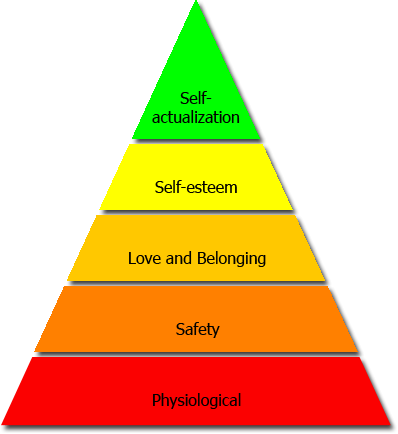
In 1943, American psychologist Abraham Maslow published a work asserting that humans are motivated by an ascending set of needs.  It is sometimes represented by a triangle with our most basic needs, our physiological needs, at the bottom and moving up towards our highest need, self-actualization.

maslow-need-hierarchy

While I doubt that the complexity of human behavior and motivation can be boiled down to a few simple categories, my own recent experience of needing has gotten me thinking about trusting God with respect to Maslow’s hierarchy of needs.

Then, in my mind I contrasted my degree of trust in God at Level 5 with my imagined trust at Level 1, physiological needs.  Trusting in God for my next bite of food or drink of water seemed in my imagination to require a deeper, more radical kind of trust than that at Level 5.  Certainly achieving some level of self-actualization is not as life-or-death as one’s need for food and water.  Could God really be trusted at this level?

I first began wondering whether the strength of my trust in God was somehow related to the stage of need in my life as represented by Maslow.  For example, if I felt the four lower needs were met and I was striving for Level 5, self-actualization, I might find it easy–casual might be a better word–to trust God.  As I cried out to him to become who He created me to be, I could console myself in the fact that He is indeed at work in me, but that becoming my true self is at least a lifelong journey.  I found could relax a bit because the lower needs were met.

For the glory of God is a living man; and the life of man consists of beholding God.

Then a very old saint, Irenaeus, came to mind.  “For the glory of God is a living man; and the life of man consists of beholding God,” he said nearly nineteen centuries ago (Against Heresies, 4.20.7).  Then in my mind the pyramid representing Maslow flipped on its head and disintegrated.  I exist because God wanted to share with me His loving life within the Trinitarian community–the magnificent relationship between Father, Son, and Holy Spirit.  Regaining unity with the Christian God is the recognized goal of one’s life with God and, in that, God is glorified as we become who we are created to be: His children who behold Him and join in loving relationship with Him.

For the maturing Christian, the needs of physiology, safety, socializing, and esteem increasingly take a back seat to actualization.  However, it is not Maslow’s self-actualization in the sense of a self-help project I undertake for myself.  It is quite the contrary.  The journey toward actualization–to being reunited with God–”is not a question of merits but of co-operation, of a synergy of two wills, divine and human” (Lossky, The Mystical Theology of the Eastern Church).  I join in with what God is doing in me.

Here is where the life of a Christian becomes so contrary to what we grasp by our senses and what we know in our minds: that we must take care of, or someone must provide for first our basic needs and then our subsequent needs for us finally to be happy and fulfilled.  No.

The Christian life is my turning “towards God of [my] own free will and with all [my] longing” (Lossky).  Early on I learn to pray for my basic needs–”Give me this day my daily bread”–but as I mature with God my needs change from things to a singular longing for Him.  My faith becomes that of gazing at Him and my trust in Him becomes ruthless.  “Little by little the soul reintegrates itself, regains its unity, and particular petitions begin to disappear making them superfluous, as God answers prayer by making manifest His all-embracing providence.  There is an end to petition when the soul entrusts itself wholly to the will of God.” (Lossky).

God knows and provides for all of our needs in His way and His timing as He draws us toward Him; we gaze upon His face as we seek to follow His leading–it is the Divine Dance.  This is the state of a person truly alive, and persons on this journey bring glory God.  It is a state in which even the “great saints” of human history moved in and out of; after all, our deification, being united in relationship with God, is a very, very long journey.

So, get on the dance floor with God; its okay if you step on His toes as you learn the steps and rhythm of the dance and to follow His lead.

Perspectives

14 Wednesday Aug 2013

Posted by CurateMike in All, Self

≈ 3 Comments

Tags

Dietrich Bonhoeffer, false self, God, Holy spirit, Jesus, perspectives, shadow self, true self

Who am I?

Am I then really that which other men tell of?  Or am I only what I myself know of myself?

Who am I? This or the Other?  Am I one person today and tomorrow another?  Am Iboth at once?

—“Who Am I?”, Dietrich Bonhoeffer

Comedy-Tragedy

These questions so eloquently captured by Bonhoeffer have haunted me.

Have you ever had this thought: “If another person knew me, really knew me, they couldn’t possibly like me”?  You know the “real me” person I mean, the “inner you” that you go to great lengths to hide–yeah, that’s the one right there living in the shadow of the person you project–if they really knew that person they wouldn’t like you…or so you tell yourself because you know yourself better than anyone.

Have you ever had a really good friend tell you that they see good something in you that you know couldn’t possibly be true because, after all, you see the backstage areas of your life?  You nod at their comment in appreciation, perhaps even feeling a little flustered while protesting against their observation, while down deep wishing that what they said were indeed true.  What they say can’t be true, you tell yourself, because they don’t know the “real you,” and you, of course, know yourself better than anyone.on you project–if they really knew that person they wouldn’t like you…or so you tell yourself because you know yourself better than anyone.

Have you ever had some well-meaning fellow Christian tell you that God loves you for who you are?  You nod your head knowingly because it is a fact straight from your Bible; however, somewhere down deep you know it is a lie…after all, the “real you” is unlovable and, after all, you know yourself better than anyone.

What if you are wrong?  What if you aren’t the best judge of who you are.

What if you are wrong?  What if you aren’t the best judge of who you are.

What if there are other persons who know you at least as well as you know yourself and perhaps better than you know yourself?  I am coming to believe that there are three valid perspectives of me…

God’s Perspective

The first perspective is that of God.  If I am a follower of Jesus, then God has adopted me as His child.  To use the language of the Apostle Paul, God sees me-in-Jesus (Christ).  That’s a funny theological concept.  How can I be in another person?  Well, it is a bit of a mystery in the same way that two married people in a healthy marriage slowly and mysteriously become as one, their very persons separate but intertwined.

The practical outworking of this is that when God looks at me He sees me in the same way as He sees His Son, Jesus.  After all, I am His son, too (or daughter, ladies).  Imagine God looking at you that way.  And here’s the best part: He already knows about that shadowy person inside that I try to hide even from Him, and He still sees me as His most beloved child.

Sure, there’s a bit more to this perspective.  God wants me to really become like Jesus, so in addition to offering His unconditional love He helps me through His Holy Spirit to live my life in a way that I am being actually transformed into the likeness of Jesus.

Don’t get too bogged down in this extra stuff just now; the point is that God sees me as His child in the very same way He sees His real Son, Jesus.  God looks at me and sees me-in-Jesus.  That is His perspective.

Other’s Perspective

What about these other people who see something in me I don’t see.  Well, it is not just any other people that will see this truthfully.  It is too easy to fool the masses; with a few deft moves I can pull the wool over their eyes.  Or, they might see only a snapshot of me and rush to a good or poor judgment of me.

No, I’m talking about those very few people who really know me.  Those people I let into the innermost circle of my life; those to whom I tell of my hopes and dreams and expose my weakness and failures.  I hope you have a few people like that in your life.  These are the people who will see Jesus in you.  You cannot really know yourself without them.

As I draw closer to Jesus I become more like Him.  I am indeed a cracked pot, as they say, which is a good thing.  It is through those cracks that the light of Jesus shines through.  Jesus-in-me begins to shine through those very cracks in ways of which I am not aware unless someone else points them out to me.  This is what those closest to me begin to see.  And, it’s not really them seeing me differently; rather, it is Jesus-in-them seeing Jesus-in-me.

My closest friends look at me and see Jesus-in-me.  This is their perspective.

My Perspective

Then there’s my perspective.  Unfortunately, it is the one in which I put the most stock.  It is me looking at the backside of the tapestry of my life and seeing all the loose and knotted threads.  I see the mess behind the mask.  I hear the voices unkind toward you and me in my head.  I experience the doubts and fears of life.  I recognize the false bravado.

In other words, I see the sin in me.  I’m seeing the shadow person I think I hide because he is unlovable and if you or God knew him you would reject me and I’d rather die than be rejected for who I believe am.

In reality, this shadowy figure is not separate from me but is part of me.  As I draw closer to the light of Jesus I begin to see him more clearly for the wretched person that he is (I am).  He is (I am) not something to hide…he is who I really am: the person God has redeemed by the death of Jesus.  I’m seeing me-as-redeemed.  Having this view of me allows me to see God’s great mercy and grace toward me.  Sadly for us and for God’s kingdom we too often find our identity from this perspective alone.  We too easily dismiss ourselves as unworthy to do God’s work here.

The Apostle Paul is a good case study.  We know he is God’s son (perspective 1).  We know from his writings (two-thirds of the New Testament) that he was a great man of God (perspective 2).  Yet, he calls himself the chief of all sinners (perspective 3).

Each perspective offers me something.

God’s perspective gives me the deepest truth of who I am.  From His perspective I findmy ultimate identity, security, and significance.

The perspective of my friends gives me hope that God is at work transforming my life, that His promises are not empty promises.  I really am changing; my friends see it when I don’t.  Through the eyes of close friends I see who I am being transformed into.

My perspective reminds me of God’s grace and mercy as I see what I have been redeemed from.  I see the inner ugliness and it reminds me what God did for me through Jesus on the cross.  Out of this perspective I can begin to offer  God’s love to others.

Mandella Quote

Each perspective is important.  Bonhoeffer finishes his poem with a reminder of the bedrock answer to the question, “Who am I?”:

Who am I? They mock me, these lonely questions of mine.  Whoever I am, Thou knowest, O God, I am thine!

Contemplative Prayer

05 Monday Aug 2013

Posted by CurateMike in All, Prayer

≈ Leave a comment

Tags

Contemplation, contemplative prayer, eternity, God, Jesus, philosophy of time, prayer, timelessness, Trinity

I remember the story of the old peasant, in the time of the Curé d’Ars, who spent long moments at the back of the church gazing at the image of Jesus.  One day someone asked him: “What are you doing during all this time?”. . . “I don’t do anything. I look at Him and He looks at me.”

The practice of contemplative prayer takes a lot of heat from some corners of Christianity.  It is seen by some as unbiblical or to Catholic or to passive or to quiet or to mystic or a waste of time.  Is this true?

There has been much written on both sides of the debate; rather than rehash these arguments I’d like to look at it from two different perspectives.

First is to imagine what God was doing before creation.  To even ask this question forces one to wrestle with the preceding questions of the nature of time itself and God’s relationship to it.  For example: When did time begin?  Is time itself dynamic or static?  Does God exist within time now or outside of time?  Has God changed His relationship with time?  If so, has God changed?

I believe the arguments are better that prior to creating, God existed timelessly and without beginning.  To exist timelessly means that God existed “changelessly alone, and no event disturbs this tranquility.  There is no before, no after, no temporal passage, no future phase of His life.  There is just God.” (Time and Eternity, Wm Lane Craig).  If so, then, one cannot even ask the question, “What did God do prior to creation?”.  God did not do anything, He could only be, only exist as God.

However, God has eternally existed as the three-in-one God: Father, Son [Jesus], Holy Spirit.  Somehow in this unchanging timelessness God has the ability to love.  Jesus, while on earth in human physical form, said this: …”for You [Father God] loved me [Jesus] before the foundation of the world” (John 17:24). Further, this changeless timelessness allowed Jesus to exist in a state of glory with His Father (John 17:5).  So, whatever we mean by a state of timelessness before creation–an existence of perfect tranquility–it must allow for love and glory between persons.

What if this timeless state was a state of perfect contemplation?  Father experiencing the Son, the Son experiencing the Father, each in perfectly loving union with the Other through the Spirit.  Perhaps this is perfect contemplation.

A second perspective is to consider what it means to be happy.  Plato (Symposium) recognized that our desire for happiness is intrinsic to us; we desire to be happy by nature.  In practice, we notice that we don’t seem to ask each other, “Why do you want to be happy?”  None of us would know the answer…it just seems obvious that we would due to something beyond us.

Yet, in our pursuit to fulfill our desire for happiness we run headlong into the paradox of hedonism: we desire happiness by nature; however, we cannot make ourselves happy.  This itself is a source of great unhappiness; our deepest desire is for something that we cannot give ourselves.  We seem to expend great time, energy, and resources seeking happiness.  We collect stuff, have adventures, change jobs, pack our heads with knowledge, and perhaps even collect people in our pursuit of our own happiness.  This may succeed for some time; however, we seem to know in the depths of our soul that the happiness gained even from the best of these things is somehow lacking.  We find ourselves desiring something more, something deeper than pleasure gained from them.

Back to God.  As a perfect being, God is perfectly happy.  He depends on nothing for His happiness, He finds perfect happiness in Himself alone not needing us or any of His creation.  And, as we saw above, prior to creation God was in perfect contemplation within Himself, Father, Son, Spirit.  Perfect happiness in perfect contemplation.

One thing I have asked from the Lord, that I shall seek: That I may dwell in the house of the Lord all the days of my life, to behold the beauty of the Lord…

Psalm 27:4

What, then, if our happiness comes from contemplation?  As the image-bearers of God, this shouldn’t surprise us.  If God Himself was perfectly happy in timeless contemplation before creating the universe, why wouldn’t we also find happiness in contemplation?  Who among us has not contemplated a particularly beautiful sunset, a work of art, a piece of music, etc., and found some kind of deep happiness in that moment?

If we find happiness in contemplating these earthly things, how much more so will we find in contemplating God?  “The common element in all the special forms of contemplation,” says philosopher Joseph Pieper, “is the loving, yearning, affirming bent toward happiness which is the same as God Himself…love alone makes it possible for contemplation to satiate the human heart with the experience of supreme happiness” (Happiness & Contemplation).

“In…contemplation,” Pieper goes on to say, “man takes a step out of time.”  Evelyn Underhill puts it this way: “This is the ‘passive union’ of contemplation: a temporary condition in which the subject receives a double conviction of ineffable happiness and ultimate reality” (Mysticism).

Perhaps in the fleeting moments of true contemplative prayer we step out of time and into the timelessness of our eternal God where we find both true happiness and ultimate reality.

Motionless and Silent

23 Tuesday Jul 2013

Posted by CurateMike in All, Humankind

≈ 3 Comments

Tags

Father, God, human history, Jesus, motionless, silent, Tweet, Twitter

After they had finished nailing him to the cross and were waiting for him to die, they whiled away the time by throwing dice for his clothes…From noon to three, the whole earth was dark. Around midafternoon Jesus groaned out of the depths, crying loudly…“My God, my God, why have you abandoned me?”  (Gospel of Matthew, c27, v45-46)

Christians believe that the life, death, and resurrection of Jesus is the central point of human history.  It is God Himself making it possible for those who believe in Jesus as God, who realize they need what He did for them in His death, and who accept Him as God of their lives to be transformed into sons and daughters of God.

The death of Jesus is of particular importance because it is there that Christians believe God took upon Himself the full weight of the sin of humanity and, in death, paid the price for it that we cannot fully pay.

There are many mysterious things about Jesus’ death.  This is what strikes me today: the motionlessness and silence of it.

Jesus was nailed to the cross.  He couldn’t move.  It seems that throughout His life He moved at a deliberate pace toward being motionless.  In the end, Jesus was nailed down and waited to die.  He couldn’t have had one more meeting if He had wanted to.  He couldn’t tweet the news moment by moment: “@SonofMan is thirsty on #thecross.”  The few things He could have done He chose not to: calling down angels to save Himself or making sure we understood this as an object lesson.

He chose to be motionless and, as far as enlightening us further, silent.  He had done what He came for and in the face of the ultimate injustice, humiliation, and taunting, was simply motionless and silent, content to allow this profound event of human history to occur in His stillness.

God, His Father, was also motionless and silent.  God the Father did not act to save His Son.  When Jesus cried out to Him, “Where are you?”, there was nothing but silence.  God could have made a show of it, ensuring that we all understood what was happening; after all, God had used special effects to gain the attention of His people quite effectively throughout history: lightening, hail, fire, whirlwinds, earthquakes, cedar trees breaking…

But, in this moment, this most profound event in human history, God the Father was silent.

The event, it seems, required no exclamation point of motion or noise.  This is in such contrast to our lives.

The event, it seems, required no exclamation point of motion or noise.

This is in such contrast to our lives.

We race around; multitasking is highly valued despite research showing that it decreases our performance.  We ask each other, “What did you do today?”  We measure our absolute and relative worth by our current performance and our past accomplishments–with emphasis on our current performance (“What have you done for me lately?”).  We are always on the move.  We are always trying to create, change, or fix something.

And we are always making noise.  We have something to say and we want to be heard.  We talk over each other in our zeal to be heard.  We are free with our advice to another.  Have you ever paused to take stock of the noise in the world?  Perhaps, like attending a loud rock concert, we find today that our hearing is failing and what once was loud is now acceptable.

There are certainly times to act and times to speak.  Aren’t there also times to be still and be quiet?  Imagine facing an important moment in your life or a tremendous injustice to you and responding as Jesus did by being motionless and silent.  Can we even conceive of that possibility anymore?  How would our closest relationships be transformed if we dared to be occasionally motionless instead of always trying to fix, to be silent instead of trying to advise?

In our deepest pain, the fundamental loneliness and brokenness of the so-called human condition, we too often act out or shout out trying to relieve our pain instead of persevering, motionless and in silence.  We hurry to alleviate the pain of others and miss the times when it is better to simple be with the other, motionless and silent.

To be motionless and silent when Jesus asks us, to persevere and suffer with Jesus in this way is the only path along which our character will be transformed into that of God’s.

Navigating Life

25 Monday Feb 2013

Posted by CurateMike in All, Life

≈ 9 Comments

Tags

Alice in Wonderland, Christianity, Eliot, God, Jesus, Lewis Carroll, Life, Pieper, Trinity

[Alice went on,] “Would you tell me, please, which way I ought to go from here?”
“That depends a good deal on where you want to get to,” said the Cat.
“I don’t much care where—” said Alice.
“Then it doesn’t matter which way you go,” said the Cat.
“—so long as I get SOMEWHERE,” Alice added as an explanation.
“Oh, you’re sure to do that,” said the Cat, “if you only walk long enough.”
–Lewis Carroll, Alice in Wonderland

“Are you leaving from? Or are you going to?”–a recent question to me from a friend.

Sometimes I wonder whether life isn’t just a simple navigational problem. I used to be an airline pilot. For each flight I knew where I was starting from; where I was going; why I was going there; what the obstacles were between here and there (e.g., weather, mountains); what the best route of flight was for the triple goals of maintaining the schedule, fuel economy, and passenger comfort; and how much fuel I needed to get there.

My journey through life has often seemed less precise. There have been times when I have been leaving from somewhere; I have found the situation I’m in intolerable for any number of reasons and I’m off to something else, anything else “so long as I get SOMEWHERE,” as Alice says. I’ve left where I am with no clear destination in mind. In “leaving from” I knew my starting point but any of many destinations will do.

That’s the thing about leaving from. The destination is often unknown; when I have wanted to leave where I am all that I know is that I want to be where I am now not. My reasons for leaving have sometimes been to escape: escape from the big city, escape from life in a cubicle, escape from a dreary job, escape from routine, escape from a difficult situation, escape from painful memories…escape to anywhere but here.

For some, a life of leaving is enjoyable. No roots, no commitment, no responsibilities…it is the journey that matters. It is a life of exploration and excitement. Spontaneity rules. Perhaps you
have seen the t-shirt that says, “Not everyone who wanders is lost.”

I have a natural curiosity and restlessness that has often provided fuel for my life’s journey. It has been the driving force behind some of my leavings. “The grass is greener,” I have told myself more than once, “just on the other side of the next fence.” Just over there it will be better, there will be new things to see and learn, new experiences to be had. And, often that has proved true.

Recently, however, I’ve begun to think differently about leaving. No, not about changing locations, but about the idea of “leaving from” vs “going to.” In “going to” the destination is known. One can start a going to journey from anywhere, but the destination is known. As I reflected on years of leaving–I’ve lived in 9 states and had 5 careers, so far–here is the realization to which I’ve come, strange as it may sound to some: all of my leavings have been goings. Whether fueled by curiosity, restlessness, or escape, all of my instances of leaving have been caused by my search for something, by being drawn toward something that has been unknown to me for most of my life.

In his little book, Happiness & Contemplation, philosopher Pieper claims that “man craves by nature happiness and bliss.” By nature we crave it, it is hard-wired into us. “Why do you want to be happy?” asks Pieper. It is a question we never ask because it has no answer. We just do want it…by nature. Now there’s a lot more to this happiness thing than can be said here, but if he is right, and I think he is, then all leavings are indeed goings…going toward happiness, even if we don’t know what that is for us. Of course, some believe they are undeserving of happiness, but that is for another time.

Why do you want to be happy?

If I am simply a creation of random mutation and natural selection, then it would seen happiness should be within my grasp. Happiness should come from surviving, from achieving the four F’s: flee, fight, food, and fornication, these are all that are required for an organism’s basic survival. And yet…for millennia philosophers have known this about happiness: truest happiness is a gift, it comes to us from outside our souls. We can act to get things or to do things, each which brings us some measure of happiness; however, that which quenches our deepest thirst for happiness comes from outside of us, from contemplating the greatest good.

An African bishop named Augustine, alive some 1700 years ago in present-day Algiers, had an early life of wandering, of leaving-from-while-really-going-to…he has helped me to understand my own journey happiness. He said, “You have made us and directed us toward Yourself and our heart is restless until we rest in you” (Confessions 1.1)

You have made us and directed us toward Yourself and our heart is restless until we rest in you.

I am created by God to be in a loving relationship with Him; outside of that I will always be incomplete and unhappy in the depths of my soul. And not just any god will do, the god must be the God of tri-unity, Father, Son, Holy Spirit, each a person, each person God, yet together the one God…the great mystery of the God of Christianity. The single-person gods of other beliefs will simply not do here; a single-person god would find happiness by contemplating self, the worst sort of self-centeredness. No, none of these single-person gods are like the intrinsically outward-facing Christian God of eternal love between Father-Son-Spirit; a God of happiness spent in eternal contemplation of the Other.  It is this God that yearns for a loving relationship with each of us.

Happiness, then, comes from contemplating the greatest good, the God of Christianity. He made use that way; it is our nature. Poet T.S. Eliot described for me my journey back to God in a few lines from his poem “Little Giddings“:

We shall not cease from exploration
And the end of all our exploring
Will be to arrive where we started
And know the place for the first time.

The Nights

07 Thursday Feb 2013

Posted by CurateMike in All, Life

≈ 4 Comments

Tags

Freedom, God, Sleep, Sleeplessness, Soul, Torment

I often think that the night is more alive and more richly colored than the day.
~Vincent Van Gogh

How long the night seems to one kept awake by pain.
~Bernard Joseph Saurin, Blanche et Guiscard, translated

—–

12:30 am. No sign of sleep.

It is dark, quiet, at least in the world external to my mind, nothing is moving about…what is it about the night?

—–

There are sleepless nights that I find friendly. During these nights, there are no demands on my mind–other than the nagging back-of-my-mind reminder that the alarm clock will soon sound and I’ll be tired all day. But on these nights, even that seems an easy price to pay.

During these kinds of nights my soul feels free. During the daylight, you see, there are rules to be followed and responsibilities to perform and schedules to keep; I never feel quite free to let my mind roam: free to think thoughts that seem important to think, free to bend over and examine what is under every thought-rock, free to contemplate all there is. During the daylight hours, whenever I do let my mind roam so, I miss my turn or the driver behind me honks because the light has gone green–someone went around me today. In the daylight, I’ve found, I must always be attentive to the outer world, to be present to something or some other. How constricting and tiresome it can be.

In the early 1940s, before the US entered World War II, American pilot John Gillespie Magee Jr. wrote the poem, “High Flight,” to express what it was like for him to fly. Sadly, Magee died in a midair collision shortly after penning this poem. Having also flown, his poem is meaningful to me. And, it describes the free feeling I have in my soul during this kind of night, these friendly nights. Here’s is Magee’s poem:

Oh, I have slipped the surly bonds of earth 
And danced the skies on laughter-silvered wings; 
Sunward I’ve climbed, and joined the tumbling mirth 
Of sun-split clouds…and done a hundred things 
You have not dreamed of…wheeled and soared and swung 
High in the sunlit silence. Hov’ring there, 
I’ve chased the shouting wind along, and flung 
My eager craft through footless halls of air. 
Up, up the long, delirious, burning blue 
I’ve topped the windswept heights with easy grace 
Where never lark, or even eagle flew. 
And, while with silent, lifting mind I’ve trod 
The high untrespassed sanctity of space 
Put out my hand, and touched the face of God.

“Touching the face of God” is a phrase that resonates deeply within me. You see, contemplation, the highest form of knowing, is a form of reaching out and touching the face of God; it is beholding in love one’s Beloved. It is the greatest form of happiness. Wonderful nights!

—–

There is another night, the kind when freedom is replaced by exhaustion. During these nights my mind may race from thought to thought like a glutton shoveling food with both hands, never stopping to savor. Still other times my mind repeats thoughts, rehearsing them over and over and over and over like a scratched 45. Are you old enough to have used a record player?

—–

There is a worse night: a night of torment. There have been many of these lately. In these nights I am awake with a problem or pending conflict, my mind churning and grinding, breaking thought boulders into rocks, then into peebles, then into fine sand. Finally, after what can be hours, the problem is diagnosed, the conflict seen for what it is. And then…

…a solution begins to form. My mind shifts gears, now whining, high pitched at a very high RPM, rapidly sifting through ideas, combinations and connections with other thoughts are made, evaluated, and discarded or retained. A web of solution slowly takes shape, layer upon layer. The earlier layers are forgotten and must be rediscovered; a higher gear yet, and the whining in my head again increases in pitch with the change in RPM. Finally, the problem is solved, elegantly or the path to resolving conflict is found, usually by a dramatic, self-righteous speech. I am eager for the morrow! But wait! Is this really the answer? And, it begins again, the boulders have reformed. Is this what insanity is like? It is certainly Satan’s playground.

20130207-013139.jpg

The worst part of these nights of torment is the appearance of the light of day. Photons strike the hard-won solution or reflect the words of the self-righteous speech only to illuminate the foolishness. The night was a waste. Now I’m just tired.

—–

Worst yet are the nights filled with the pain of love. A number of spiritual writers throughout the centuries refer to God’s “wound of love.” It is the deep longing for God that He inflicts upon us, a painful yearning that will never be fully satisfied until after death. A night of sleepless longing filled with happiness and joy.

It is at this point I find that the circle is completed, the nights of wounded longing meet the friendly nights of a freed soul…

—–

1:25am, and still no sign of sleep.

← Older posts
Newer posts →

Enter your email address to follow this blog and receive notifications of new posts by email.

Join 87 other subscribers

Recent Posts

  • Bedrock
  • Healing by Fire
  • I Can Only Imagine
  • Defending Myself
  • A Lesson From Leroy

Categories

Archives

Blogs I Follow

  • O'Byrne Report
  • Spirituality and Nature

Credits

  • Desert Photo

Blog at WordPress.com.

Privacy & Cookies: This site uses cookies. By continuing to use this website, you agree to their use.
To find out more, including how to control cookies, see here: Cookie Policy
  • Subscribe Subscribed
    • curacy
    • Join 87 other subscribers
    • Already have a WordPress.com account? Log in now.
    • curacy
    • Subscribe Subscribed
    • Sign up
    • Log in
    • Report this content
    • View site in Reader
    • Manage subscriptions
    • Collapse this bar
 

Loading Comments...