
Rewards in Heaven

Tags

, , , , ,

…anyone who comes to God must believe that He exists and that He rewards those who earnestly seek Him. (Biblical book of Hebrews, c11, v6)

 Rewards in heaven.  The Bible is clear that there will be rewards in heaven.  Since the rewards are in heaven, then it seems clear that the reward is more than making it to heaven itself.  So, should we make of these rewards?

Some believe the rewards will be tangible, material things.  For example, read the following verse:

In My Father’s house are many dwelling places; if it were not so, I would have told you; for I go to prepare a place for you. (Jesus, The Gospel of John, c14, v2)

Some Christians, using this verse, imagine the rewards in heaven will be a house, sometimes we use the word “mansion” found in some biblical translations.  To demonstrate our humility, we say something like, “I don’t care if I live in an outhouse as long as I am in heaven.”  We say it as a joke; however, in my conversations with Christians it seems clear that many are expecting some sort of tangible gift from God as a reward.

I think that this is dangerous thinking for at least three reasons.  First of all, we can turn God into Santa Clause.  ”God knows,” according to this thinking, “who has been naughty or nice.”  He will check his list twice and give me a present corresponding to my degree of goodness.  Therefore, if I am particularly saintly (usually as defined by the individual) I will find a big mansion waiting for me when I get to heaven.

Second, we turn following Jesus into a competition.  Talk of mansions or other tangible rewards invites a response of our competitive nature.  While we would never say it outright, we easily imagine ourselves living in a mansion larger or smaller than an other.

Third, recall a Christmas morning as a child.  You have been anticipating a particular present for perhaps months.  Finally, the morning arrives and you rip open the package to find the very gift for which you have longed.  For the next hours, days, or perhaps weeks, it is the center of your life.  Yet, eventually you set aside the gift for increasingly longer periods until one day you discover it in the attic, now only a fond reminder of a happy past.

I suspect that a material reward in heaven would be the same.  How far along the long corridor of eternal time will I travel before my mansion becomes passé?  I know myself to well.  It will not take long.

If our rewards are not material in nature, then what are they?  What should we expect when we get to heaven?  Jesus tells us.  He says that eternal life is knowing the true God (Father) and Jesus Himself.  The “knowing” spoken of by Jesus is the deepest, most intimate knowing possible between two beings…a mysterious union.  It is not “knowing about”; rather, it is the knowing that comes from living life with an other.  This level of intimacy does not come from a casual life together; rather, it is the result of a life of intention together through all the good times and the messy times, wanting the best for the other.

If this idea of spending an eternity to get to know God seems foreign to you, you are not alone.  In our consumerist Western culture we measure success in terms of material things, including money; perhaps you remember the old bumper sticker, “He who dies with the most toys wins.”  Also, in our world of social media, our idea of knowing people has become more about “friending” an other than expending the time and energy and commitment it takes to really know the other.

Let me propose something to you with a question.  What if our rewards in heaven is based on relationship and not materialism?  What if my reward is to finally come face-to-face with the God I love?

Certainly even in this there are “levels” of reward.  Imaging running into an acquaintance after some years.  It will likely be a nice reunion.  Contrast that with two lovers reunited after a similar period of separation.  The latter brings a sense of happiness and feeling of fulfillment, a greater “reward” than the former.

I believe it will be similar with God.  Once I am able to see His face will it be as an acquaintance or as a lover?  Don’t hear me speaking disparagingly of only being acquainted with God.  This may be as far as we have progressed in our journey with Him.  However, it would be sad if I had the chance for a deeper relationship with God and didn’t want more.

I believe that this is what God wants for us and with us.  Our Trinitarian viewpoint provides us with an image of a God of three persons—Father, Son, Spirit—who are eternally outward focused and other centered.  God is love, after all.  We were created to be in loving union with Him.  Our union with Him is a reward for Him, too, as He joins with us, His beloved daughters and sons.

If I’m right and if eternal life is to be in a loving relationship with God, to know Him in the most intimate sense, then why wait?  Why not start now so that when you get to heaven you will run into the arms of the one you most love.  What better reward could there be?
The Glory of God and Abraham Maslow

Tags

, , , , , ,

God then told Elijah, “Get out of here, and fast. Head east and hide out at the Kerith Ravine on the other side of the Jordan River. You can drink fresh water from the brook; I’ve ordered the ravens to feed you.”  Elijah obeyed God’s orders. He went and camped in the Kerith canyon on the other side of the Jordan. And sure enough, ravens brought him his meals, both breakfast and supper, and he drank from the brook.

Biblical book, 1Kings, ch 17, verses 2-6

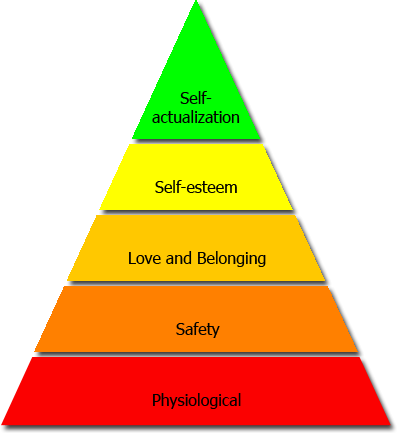
In 1943, American psychologist Abraham Maslow published a work asserting that humans are motivated by an ascending set of needs.  It is sometimes represented by a triangle with our most basic needs, our physiological needs, at the bottom and moving up towards our highest need, self-actualization.

maslow-need-hierarchy

While I doubt that the complexity of human behavior and motivation can be boiled down to a few simple categories, my own recent experience of needing has gotten me thinking about trusting God with respect to Maslow’s hierarchy of needs.

Then, in my mind I contrasted my degree of trust in God at Level 5 with my imagined trust at Level 1, physiological needs.  Trusting in God for my next bite of food or drink of water seemed in my imagination to require a deeper, more radical kind of trust than that at Level 5.  Certainly achieving some level of self-actualization is not as life-or-death as one’s need for food and water.  Could God really be trusted at this level?

I first began wondering whether the strength of my trust in God was somehow related to the stage of need in my life as represented by Maslow.  For example, if I felt the four lower needs were met and I was striving for Level 5, self-actualization, I might find it easy–casual might be a better word–to trust God.  As I cried out to him to become who He created me to be, I could console myself in the fact that He is indeed at work in me, but that becoming my true self is at least a lifelong journey.  I found could relax a bit because the lower needs were met.

For the glory of God is a living man; and the life of man consists of beholding God.

Then a very old saint, Irenaeus, came to mind.  “For the glory of God is a living man; and the life of man consists of beholding God,” he said nearly nineteen centuries ago (Against Heresies, 4.20.7).  Then in my mind the pyramid representing Maslow flipped on its head and disintegrated.  I exist because God wanted to share with me His loving life within the Trinitarian community–the magnificent relationship between Father, Son, and Holy Spirit.  Regaining unity with the Christian God is the recognized goal of one’s life with God and, in that, God is glorified as we become who we are created to be: His children who behold Him and join in loving relationship with Him.

For the maturing Christian, the needs of physiology, safety, socializing, and esteem increasingly take a back seat to actualization.  However, it is not Maslow’s self-actualization in the sense of a self-help project I undertake for myself.  It is quite the contrary.  The journey toward actualization–to being reunited with God–”is not a question of merits but of co-operation, of a synergy of two wills, divine and human” (Lossky, The Mystical Theology of the Eastern Church).  I join in with what God is doing in me.

Here is where the life of a Christian becomes so contrary to what we grasp by our senses and what we know in our minds: that we must take care of, or someone must provide for first our basic needs and then our subsequent needs for us finally to be happy and fulfilled.  No.

The Christian life is my turning “towards God of [my] own free will and with all [my] longing” (Lossky).  Early on I learn to pray for my basic needs–”Give me this day my daily bread”–but as I mature with God my needs change from things to a singular longing for Him.  My faith becomes that of gazing at Him and my trust in Him becomes ruthless.  “Little by little the soul reintegrates itself, regains its unity, and particular petitions begin to disappear making them superfluous, as God answers prayer by making manifest His all-embracing providence.  There is an end to petition when the soul entrusts itself wholly to the will of God.” (Lossky).

God knows and provides for all of our needs in His way and His timing as He draws us toward Him; we gaze upon His face as we seek to follow His leading–it is the Divine Dance.  This is the state of a person truly alive, and persons on this journey bring glory God.  It is a state in which even the “great saints” of human history moved in and out of; after all, our deification, being united in relationship with God, is a very, very long journey.

So, get on the dance floor with God; its okay if you step on His toes as you learn the steps and rhythm of the dance and to follow His lead.

Perspectives

Tags

, , , , , , ,

Who am I?

Am I then really that which other men tell of?  Or am I only what I myself know of myself?

Who am I? This or the Other?  Am I one person today and tomorrow another?  Am Iboth at once?

“Who Am I?”, Dietrich Bonhoeffer

Comedy-Tragedy

These questions so eloquently captured by Bonhoeffer have haunted me.

Have you ever had this thought: “If another person knew me, really knew me, they couldn’t possibly like me”?  You know the “real me” person I mean, the “inner you” that you go to great lengths to hide–yeah, that’s the one right there living in the shadow of the person you project–if they really knew that person they wouldn’t like you…or so you tell yourself because you know yourself better than anyone.

Have you ever had a really good friend tell you that they see good something in you that you know couldn’t possibly be true because, after all, you see the backstage areas of your life?  You nod at their comment in appreciation, perhaps even feeling a little flustered while protesting against their observation, while down deep wishing that what they said were indeed true.  What they say can’t be true, you tell yourself, because they don’t know the “real you,” and you, of course, know yourself better than anyone.on you project–if they really knew that person they wouldn’t like you…or so you tell yourself because you know yourself better than anyone.

Have you ever had some well-meaning fellow Christian tell you that God loves you for who you are?  You nod your head knowingly because it is a fact straight from your Bible; however, somewhere down deep you know it is a lie…after all, the “real you” is unlovable and, after all, you know yourself better than anyone.

What if you are wrong?  What if you aren’t the best judge of who you are.

What if you are wrong?  What if you aren’t the best judge of who you are.

What if there are other persons who know you at least as well as you know yourself and perhaps better than you know yourself?  I am coming to believe that there are three valid perspectives of me…

God’s Perspective

The first perspective is that of God.  If I am a follower of Jesus, then God has adopted me as His child.  To use the language of the Apostle Paul, God sees me-in-Jesus (Christ).  That’s a funny theological concept.  How can I be in another person?  Well, it is a bit of a mystery in the same way that two married people in a healthy marriage slowly and mysteriously become as one, their very persons separate but intertwined.

The practical outworking of this is that when God looks at me He sees me in the same way as He sees His Son, Jesus.  After all, I am His son, too (or daughter, ladies).  Imagine God looking at you that way.  And here’s the best part: He already knows about that shadowy person inside that I try to hide even from Him, and He still sees me as His most beloved child.

Sure, there’s a bit more to this perspective.  God wants me to really become like Jesus, so in addition to offering His unconditional love He helps me through His Holy Spirit to live my life in a way that I am being actually transformed into the likeness of Jesus.

Don’t get too bogged down in this extra stuff just now; the point is that God sees me as His child in the very same way He sees His real Son, Jesus.  God looks at me and sees me-in-Jesus.  That is His perspective.

Other’s Perspective

What about these other people who see something in me I don’t see.  Well, it is not just any other people that will see this truthfully.  It is too easy to fool the masses; with a few deft moves I can pull the wool over their eyes.  Or, they might see only a snapshot of me and rush to a good or poor judgment of me.

No, I’m talking about those very few people who really know me.  Those people I let into the innermost circle of my life; those to whom I tell of my hopes and dreams and expose my weakness and failures.  I hope you have a few people like that in your life.  These are the people who will see Jesus in you.  You cannot really know yourself without them.

As I draw closer to Jesus I become more like Him.  I am indeed a cracked pot, as they say, which is a good thing.  It is through those cracks that the light of Jesus shines through.  Jesus-in-me begins to shine through those very cracks in ways of which I am not aware unless someone else points them out to me.  This is what those closest to me begin to see.  And, it’s not really them seeing me differently; rather, it is Jesus-in-them seeing Jesus-in-me.

My closest friends look at me and see Jesus-in-me.  This is their perspective.

My Perspective

Then there’s my perspective.  Unfortunately, it is the one in which I put the most stock.  It is me looking at the backside of the tapestry of my life and seeing all the loose and knotted threads.  I see the mess behind the mask.  I hear the voices unkind toward you and me in my head.  I experience the doubts and fears of life.  I recognize the false bravado.

In other words, I see the sin in me.  I’m seeing the shadow person I think I hide because he is unlovable and if you or God knew him you would reject me and I’d rather die than be rejected for who I believe am.

In reality, this shadowy figure is not separate from me but is part of me.  As I draw closer to the light of Jesus I begin to see him more clearly for the wretched person that he is (I am).  He is (I am) not something to hide…he is who I really am: the person God has redeemed by the death of Jesus.  I’m seeing me-as-redeemed.  Having this view of me allows me to see God’s great mercy and grace toward me.  Sadly for us and for God’s kingdom we too often find our identity from this perspective alone.  We too easily dismiss ourselves as unworthy to do God’s work here.

The Apostle Paul is a good case study.  We know he is God’s son (perspective 1).  We know from his writings (two-thirds of the New Testament) that he was a great man of God (perspective 2).  Yet, he calls himself the chief of all sinners (perspective 3).

Each perspective offers me something.

God’s perspective gives me the deepest truth of who I am.  From His perspective I findmy ultimate identity, security, and significance.

The perspective of my friends gives me hope that God is at work transforming my life, that His promises are not empty promises.  I really am changing; my friends see it when I don’t.  Through the eyes of close friends I see who I am being transformed into.

My perspective reminds me of God’s grace and mercy as I see what I have been redeemed from.  I see the inner ugliness and it reminds me what God did for me through Jesus on the cross.  Out of this perspective I can begin to offer  God’s love to others.

Mandella Quote

Each perspective is important.  Bonhoeffer finishes his poem with a reminder of the bedrock answer to the question, “Who am I?”:

Who am I? They mock me, these lonely questions of mine.  Whoever I am, Thou knowest, O God, I am thine!

Contemplative Prayer

Tags

, , , , , , , ,

I remember the story of the old peasant, in the time of the Curé d’Ars, who spent long moments at the back of the church gazing at the image of Jesus.  One day someone asked him: “What are you doing during all this time?”. . . “I don’t do anything. I look at Him and He looks at me.”

The practice of contemplative prayer takes a lot of heat from some corners of Christianity.  It is seen by some as unbiblical or to Catholic or to passive or to quiet or to mystic or a waste of time.  Is this true?

There has been much written on both sides of the debate; rather than rehash these arguments I’d like to look at it from two different perspectives.

First is to imagine what God was doing before creation.  To even ask this question forces one to wrestle with the preceding questions of the nature of time itself and God’s relationship to it.  For example: When did time begin?  Is time itself dynamic or static?  Does God exist within time now or outside of time?  Has God changed His relationship with time?  If so, has God changed?

I believe the arguments are better that prior to creating, God existed timelessly and without beginning.  To exist timelessly means that God existed “changelessly alone, and no event disturbs this tranquility.  There is no before, no after, no temporal passage, no future phase of His life.  There is just God.” (Time and Eternity, Wm Lane Craig).  If so, then, one cannot even ask the question, “What did God do prior to creation?”.  God did not do anything, He could only be, only exist as God.

However, God has eternally existed as the three-in-one God: Father, Son [Jesus], Holy Spirit.  Somehow in this unchanging timelessness God has the ability to love.  Jesus, while on earth in human physical form, said this: …”for You [Father God] loved me [Jesus] before the foundation of the world” (John 17:24). Further, this changeless timelessness allowed Jesus to exist in a state of glory with His Father (John 17:5).  So, whatever we mean by a state of timelessness before creation–an existence of perfect tranquility–it must allow for love and glory between persons.

What if this timeless state was a state of perfect contemplation?  Father experiencing the Son, the Son experiencing the Father, each in perfectly loving union with the Other through the Spirit.  Perhaps this is perfect contemplation.

A second perspective is to consider what it means to be happy.  Plato (Symposium) recognized that our desire for happiness is intrinsic to us; we desire to be happy by nature.  In practice, we notice that we don’t seem to ask each other, “Why do you want to be happy?”  None of us would know the answer…it just seems obvious that we would due to something beyond us.

Yet, in our pursuit to fulfill our desire for happiness we run headlong into the paradox of hedonism: we desire happiness by nature; however, we cannot make ourselves happy.  This itself is a source of great unhappiness; our deepest desire is for something that we cannot give ourselves.  We seem to expend great time, energy, and resources seeking happiness.  We collect stuff, have adventures, change jobs, pack our heads with knowledge, and perhaps even collect people in our pursuit of our own happiness.  This may succeed for some time; however, we seem to know in the depths of our soul that the happiness gained even from the best of these things is somehow lacking.  We find ourselves desiring something more, something deeper than pleasure gained from them.

Back to God.  As a perfect being, God is perfectly happy.  He depends on nothing for His happiness, He finds perfect happiness in Himself alone not needing us or any of His creation.  And, as we saw above, prior to creation God was in perfect contemplation within Himself, Father, Son, Spirit.  Perfect happiness in perfect contemplation.

One thing I have asked from the Lord, that I shall seek: That I may dwell in the house of the Lord all the days of my life, to behold the beauty of the Lord…

Psalm 27:4

What, then, if our happiness comes from contemplation?  As the image-bearers of God, this shouldn’t surprise us.  If God Himself was perfectly happy in timeless contemplation before creating the universe, why wouldn’t we also find happiness in contemplation?  Who among us has not contemplated a particularly beautiful sunset, a work of art, a piece of music, etc., and found some kind of deep happiness in that moment?

If we find happiness in contemplating these earthly things, how much more so will we find in contemplating God?  “The common element in all the special forms of contemplation,” says philosopher Joseph Pieper, “is the loving, yearning, affirming bent toward happiness which is the same as God Himself…love alone makes it possible for contemplation to satiate the human heart with the experience of supreme happiness” (Happiness & Contemplation).

“In…contemplation,” Pieper goes on to say, “man takes a step out of time.”  Evelyn Underhill puts it this way: “This is the ‘passive union’ of contemplation: a temporary condition in which the subject receives a double conviction of ineffable happiness and ultimate reality” (Mysticism).

Perhaps in the fleeting moments of true contemplative prayer we step out of time and into the timelessness of our eternal God where we find both true happiness and ultimate reality.

Motionless and Silent

Tags

, , , , , , ,

After they had finished nailing him to the cross and were waiting for him to die, they whiled away the time by throwing dice for his clothes…From noon to three, the whole earth was dark. Around midafternoon Jesus groaned out of the depths, crying loudly…“My God, my God, why have you abandoned me?”  (Gospel of Matthew, c27, v45-46)

Christians believe that the life, death, and resurrection of Jesus is the central point of human history.  It is God Himself making it possible for those who believe in Jesus as God, who realize they need what He did for them in His death, and who accept Him as God of their lives to be transformed into sons and daughters of God.

The death of Jesus is of particular importance because it is there that Christians believe God took upon Himself the full weight of the sin of humanity and, in death, paid the price for it that we cannot fully pay.

There are many mysterious things about Jesus’ death.  This is what strikes me today: the motionlessness and silence of it.

Jesus was nailed to the cross.  He couldn’t move.  It seems that throughout His life He moved at a deliberate pace toward being motionless.  In the end, Jesus was nailed down and waited to die.  He couldn’t have had one more meeting if He had wanted to.  He couldn’t tweet the news moment by moment: “@SonofMan is thirsty on #thecross.”  The few things He could have done He chose not to: calling down angels to save Himself or making sure we understood this as an object lesson.

He chose to be motionless and, as far as enlightening us further, silent.  He had done what He came for and in the face of the ultimate injustice, humiliation, and taunting, was simply motionless and silent, content to allow this profound event of human history to occur in His stillness.

God, His Father, was also motionless and silent.  God the Father did not act to save His Son.  When Jesus cried out to Him, “Where are you?”, there was nothing but silence.  God could have made a show of it, ensuring that we all understood what was happening; after all, God had used special effects to gain the attention of His people quite effectively throughout history: lightening, hail, fire, whirlwinds, earthquakes, cedar trees breaking…

But, in this moment, this most profound event in human history, God the Father was silent.

The event, it seems, required no exclamation point of motion or noise.  This is in such contrast to our lives.

The event, it seems, required no exclamation point of motion or noise.

This is in such contrast to our lives.

We race around; multitasking is highly valued despite research showing that it decreases our performance.  We ask each other, “What did you do today?”  We measure our absolute and relative worth by our current performance and our past accomplishments–with emphasis on our current performance (“What have you done for me lately?”).  We are always on the move.  We are always trying to create, change, or fix something.

And we are always making noise.  We have something to say and we want to be heard.  We talk over each other in our zeal to be heard.  We are free with our advice to another.  Have you ever paused to take stock of the noise in the world?  Perhaps, like attending a loud rock concert, we find today that our hearing is failing and what once was loud is now acceptable.

There are certainly times to act and times to speak.  Aren’t there also times to be still and be quiet?  Imagine facing an important moment in your life or a tremendous injustice to you and responding as Jesus did by being motionless and silent.  Can we even conceive of that possibility anymore?  How would our closest relationships be transformed if we dared to be occasionally motionless instead of always trying to fix, to be silent instead of trying to advise?

In our deepest pain, the fundamental loneliness and brokenness of the so-called human condition, we too often act out or shout out trying to relieve our pain instead of persevering, motionless and in silence.  We hurry to alleviate the pain of others and miss the times when it is better to simple be with the other, motionless and silent.

To be motionless and silent when Jesus asks us, to persevere and suffer with Jesus in this way is the only path along which our character will be transformed into that of God’s.

Naked and Unafraid

Tags

, , , , , , , ,

[All of creations stops, there is silence in the heavens and the earth…will they or won’t they?  The crunch of a stolen bite taken from forbidden fruit is deafening.  At the sound of the proprietor approaching the offenders drop the evidence and run.…] then the Lord God called to Adam, and said to him, “Where are you?” He said, “I heard the sound of You in the garden, and I was afraid because I was naked; so I hid myself.” And God said, “Who told you that you were naked? Have you eaten from the tree of which I commanded you not to eat?”

Paraphrase from the first book of the Bible–Genesis ch 3, verses 9-11 (New American Standard Translation)

God prohibited the first humans, Adam and Eve, from eating fruit from the tree of knowledge so that they would not know good from evil and become “like God” (Genesis 3:5, 22).  They took a bite anyway.  Then, realizing they were naked they hid from God in fear.

There is so much to think about in these few verses, so much explanatory power regarding the state of the world today.  However, one particular thing is on my mind: being naked and afraid.

I don’t know specifically what was in their respective minds to cause fear when they suddenly realized their nakedness; however, I know what is in my mind, and it is more than about a lack of clothes.

We throw around words of nakedness with ease: transparency in Government, authentic community, being real with each other.  Our language suggests we want such nakedness with each other, but do we really?  Yes and no.  Imagine standing before another human naked in the deepest sense of that word, no barriers at all.  Your most intimate thoughts, feelings, hopes, dreams, desires, fears…all that you are fully revealed, open for inspection by another.  I think we each desperately long for that kind of acceptance, but we fear laughter and ultimately, rejection, because to be accepted is to be loved; rejection is death.

We so yearn for acceptance and fear rejection that we consciously and unconsciously create a false self, a Glittering Image, so that we will find love in the acceptance from another.  Some of our falseness we are aware of, we call it The Mask behind which we hide.  Our talk of “being authentic” only refers to each coming out from behind our respective Masks.  However, our false identity is far deeper than The Mask; we are mostly unaware of it until something happens to bring it to light.  Our idea of an acceptable “normal” has been constructed by the influences of parents, friends, favorite celebrities, authors, teachers, the media, advertisers, businesses, our culture…we are helpless to see beyond what we have come to believe and the things to which we cling.

We are helpless, that is, until something happens that challenges what we believe about “normal.”  I recently had such an experience.  I now find my self with no status to hide behind because I’m not making any money.  I have no 40-hour-a-week job to define myself.  I have no office and co-workers in which to busy myself in and with.  I have no established church family to immerse myself.  I have no strategic goals to work toward to give me the illusion of self value.  It is a new kind of nakedness and through it more of my own Glittering Image has been revealed.  This experience is showing me more of what I cling too and use to define myself and find acceptance from you.

It is an uncomfortable place to be and questions swirl in my mind–

Where have I placed my sense of security?  In a paycheck or money in the bank?  What happens when I am no longer in control of that?

It is an uncomfortable place to be and questions swirl in my mind–

What does it mean to work?  What counts as “work”?  I now have a “job” as a Christian missionary.  God has to make connections with people, it is out of my hands.  I can only wait on Him, but what if I “work,” as I have previously defined it, less than 8 hours a day?  What then?

How do I measure productivity?  I’m not building widgets, and meeting with people produces little immediate, measurable results.  Am I just a drain on this society that so values results?

From where does my self-worth come?  “Missionary” is not as cool a job title as “airline pilot,” which I once had.  Am I defined by my title and job description?  From where do my real identity and value come?

God, it seems, is no respecter of my comfortable paradigms.

God, it seems, is no respecter of my comfortable paradigms.

I know most of the answers in my head; however, living as though I believe them is different.  The questions are no longer theoretical, they are real and immediate.

All of our answers are in some way illusionary.  We believe we know what it is to be “normal.”  We believe we can control our destiny and manage our own security.  We believe we can define ourselves by what we do or what we wear or what we have.  In reality, we have never been able to do any of these things.  Like Adam and Eve, we move through life relying on our own knowledge of good and evil, each putting up a Glittering Image for all to see because, in our fear of being seen naked, we hide from ourselves, from each other, and from God.

So strong is the pull of the Glittering Image that I can already feel the urge to use my job as missionary to fulfill my need to for acceptance.  I could quite easily begin to  define myself as “one of God’s people called into missionary life.”  It would be very easy to bask in the wide acceptance of my fellow Christians, perhaps even allowing myself to be placed on a pedestal because of the “great sacrifice you’re making for God” as a missionary.  I can easily slip in a casual comment that I’m more Jesus-like in my poverty.

Our need for acceptance tugs even more subtly and more tragically.  I’ve discovered that even trying to be like Jesus can become another form of a Glittering Image.  Before I’m burned at the stake, history shows us that people have outwardly tried to be like Jesus with the inner motive of power, greed, etc.  These are the obvious examples.  But even more dangerous to the Christian, one can strain and groan to be outwardly like Jesus (as we have constructed Him) because in some circles it is not acceptable to be a Christian struggling with real problems, wrestling with serious questions about one’s faith, battling despair…to be living a life that is not “fine.”  Sadly, in some churches it is simply not acceptable to be “naked and unafraid.”

With the God of the Bible we can find unconditional love in our nakedness.  We don’t have to cover ourselves and hide in the bushes.  But, and this can be difficult for us, it is love on His terms, not as we have distorted it.  His love casts out our fear.  God longs for us to become who we were created to be, more human not some false representation, and He wants to help; He sent us His Spirit to help us.  Even as we hide in fear at our nakedness–as if we could really hide from God–He is singing over us.  What else do we really need but Him and a group of friends similarly loving Him and trying to love each other in the same way?


God’s Will

Tags

, , , , ,

For the glory of God is a living man; and the life of man consists in beholding God.

–Irenaeus; Against Heresies, 4.20.7.

For Christians, finding God’s will is of supreme importance.  Because we say we love God and believe He wants the best for us, we strive to live “in His will for us.”  In the prayer Jesus taught us to pray, we say ”Thy will be done on earth as it is in heaven.”

However, many of us want a fax, a text, an email, a telegram, handwriting on the wall, God speaking in our ear…some direct form of communication from God that will tell us straight out what to do and which is the right path ahead.  We want this because of our fundamental misunderstanding of God’s nature or our own laziness at putting in the work required in a relationship with God.  These manifests themselves in a myriad of ways: 1) we are afraid of offending God because deep down we believe He is our adversary and not our greatest supporter; 2) it is easier to live by direct command than by faith; 3) if we make a mistake, however we might come to believe that, we don’t believe God will redeem it for our good; 4) we think if we find God’s will it will be like finding the pot of gold at the end of the rainbow and our life will be great as we define it.  I’m sure you can think of other distorted reasons for finding God’s will.

Of course there are those of us who want to find God’s will because of our love for God and deep desire to please Him.

Regardless of your motivation, have you ever stopped to ask, “Regarding what I can discern, what is God’s fundamental will for me?”

Jules Toner, in his book, Discerning God’s Will, a study on Ignatius of Loyola’s writings on discernment, believes Ignatius understood God’s fundamental will for us to be for our greater glory.  That’s right, our greater glory.  Or, if we are not disposed toward Him, to lessen the harm to us.  Toner puts it this way:

The greater glory that God wills for us is our greater participation in his eternal and infinite glory.  It is from God its giver and to God who is glorified in us.  It is in us as our fullness of life and for us whose happiness is in being glory to God and giving his glory to each other. (23)

It sounds circular, doesn’t it.  God wants our greater glory so that we glorify Him.  Not so, because it all precedes from God.  One meaning of the word “glory,” as used in the Bible, is “the essence of a person.”  So, God gives us His glory so that we might become truly who we were created to be: humans in relationship with Him.  Only in this way can we escape our false identities woven out of the lies around us that tell us how we should live and what makes us significant.

As Irenaeus says, above, we glorify God by becoming all that He created us to be…fully human, and the only way that happens is in relationship with God.  And this is the essence of our life-long journey with God: the gradual shedding of the lies so that our true selves begin to emerge.  Only the experience of God’s love can cause such a transformation.

The greater glory that God wills for us is our greater participation in his eternal and infinite glory.

In practice, our desire to find God’s will is usually triggered by a choice before us.  We try to find God’s will within the context of a specific concrete situation including the people involved.  And, because we are each different, God’s will for me in a specific situation may differ from His will for you in a similar situation.  As we ponder God’s will and finally choose, our choice must always, as far as we are able to ascertain, bring God the greater glory.  Regarding what we have said above, this means that we choose that which we believe will bring us into closer relationship with Him.

Becoming our true selves in relationship with Him, that is His glory given to us and His fundamental will for us.

Rhythm of Life

Tags

, , ,

Come to me. Get away with me and you’ll recover your life. I’ll show you how to take a real rest. Walk with me and work with me—watch how I do it. Learn the unforced rhythms of grace.  –Jesus. (Gospel of Matthew c11, v28-29.  The Message.)

From somewhere in the Caribbean…

I was forty feet underwater.  In front of me was a large rock, perhaps 20 feet across.  It was coral encrusted and the fish were swarming.

I like scuba diving.  I find it peaceful; there is something about the rhythmic flow of air from the tank through the regulator into my lungs, then from my lungs through the regulator and into the water, bubbling up past my ears, that I find soothing.  The rush of air in, bubbles out. Breathe in.  Breathe out.  In.  Out.  A beautiful rhythm.

Too, it is so restful to be in a state that feels gravity free.  Divers call it “neutral buoyancy”–weighted just so that the diver, when motionless, neither floats up nor sinks down, but stays at the depth he or she is.  It must be like the weightlessness the astronauts experience (they do, in fact, train for space by being underwater in very large pools).  You move along by kicking your fin-encased feet and when you stop kicking you drift to a stop and find yourself simply suspended in the water; floating underwater, if I can use that term, as one might float in space.  Remarkable.  I’ve often wondered whether that sense of serenity while floating motionless submerged in water taps into some long ago memory of floating in the womb.

Rhythmically breathing in and out, floating weightless, the remarkable sense of quiet amidst the comforting sounds of the compressed air, and the beauty of fish and coral and sea floor…that, for me, is the majesty of scuba diving.

So, why then, if all is supposed to be tranquil, am I frustrated and fighting so hard as I float nearly upright along a vertical face of this rock?

Earlier in the dive, while swimming along a sandy bottom, I had discovered the forty feet of water above me did not dampen out the effects of the three to four foot surface swells.  Swimming perpendicular to the swells resulted in my being pushed three feet to the right, then three feet to the left.  Right.  Left.  Right.  Left.  It was lulling, sideways rhythm of a rocking motion as I progress across the bottom.

What was even more fun was swimming parallel to the surface swells.  If I did not kick at all I discovered I would move back three feet, then forward three feet.  If I kicked while the sea motion tried to move me back, I could hold my place and then I would be propelled forward much faster than normal when the motion of the water changed direction.  So, swimming in the direction of the swells became a rhythm of resisting the motion by kicking to stay in place, then resting as the current moved me forward.  Kick.  Rest.  Kick.  Rest.  Another delightful rhythm.

Now, something, I no longer remember what, had caught my attention on the face of this rock and I wanted to float peacefully and examine this thing.  What had been another enjoyable rhythm of diving–swimming with motion of the swell–had now become a great annoyance as it kept me from doing what I wanted in the way I wanted to do it.  I was thrashing about trying to maintain my depth and keep from being pushed into the rock by the now irritating to and fro of the ocean.  My arms and legs flailed.  My breathing quickened and was erratic at my exertion.  Finally, I gave up and moved away from the rock face.

That’s when I noticed the fish below me.  Beautifully colored angelfish, parrotfish, trigger Imagefish, and others moved easily around the coral darting in to nibble on a tasty piece of coral, playing tag and follow the leader while swooping in and out of narrow passages, or just resting as the motion of the water rocked them back and forth.  Motion or not, those fish were at home in their element.  It is what they knew, all they had even known.  They didn’t fight the water; rather, they had learned to move along their desired way within the larger context  of the rhythm of the water.

At that moment I realized just how much it was I who was the “fish out of water.”  To these small fish, the motion of the water was something they had experienced all of their lives.  They knew no different.  I, on the other hand, having grown up surrounded by air that rarely moves with the force to knock me off my course and with my feet firmly planted on the ground to give me great leverage to move, thrashed about in this alien environment unable to cope with this gentle motion of the water.  I didn’t embrace the rhythm of the water, moving with it that I might see what the rock had presented to me.  No, I had fought it trying to force the ocean to submit to my will and missed what the rock had for me to see.

I’m often a fish out of water in the spiritual realm, too.  Like the verse at the top says, there is a rhythm of life with Jesus.  We are invited into it.  Too often I find myself as unfamiliar with the spiritual world as I am with the undersea world. I try to bend Jesus’ rhythm to my will and, just like my ocean experience, I end up thrashing about unable to enjoy Jesus’ natural tranquility in the moment.  I think the Apostle Paul had begun to learn the secret of living in the rhythm of Jesus when he said:

Actually, I don’t have a sense of needing anything personally. I’ve learned by now to be quite content whatever my circumstances. I’m just as happy with little as with much, with much as with little. I’ve found the recipe for being happy whether full or hungry, hands full or hands empty. Whatever I have, wherever I am, I can make it through anything in the One who makes me who I am.  (Paul’s letter to the Philippians, c4, v11-13.  The Message.)

I’m just as happy with little as with much, with much as with little. I’ve found the recipe for being happy whether full or hungry, hands full or hands empty. Whatever I have, wherever I am, I can make it through anything in the One who makes me who I am.

If we get so close to Jesus that we become relationally one with Him, as He has invited us to be, then we will move with His rhythm and the turbulence around us will be unnoticed, just as it was for those fish.  Like Paul, we will be content in all situations because we are moving with the rhythm of Jesus–contentment will be natural for us.

The spiritual realm of Father God, Son Jesus, and the Spirit, which bursts forth from Their relationship, is actually our natural home, it is when we fix our eyes on this world or try to impose our will on the rhythm of Jesus that we thrash about and lose what He offers in the moment.

Draw closer to Jesus, respond to His invitation to move as He moves.  That is the first thing.  Join Him in His rhythm and find in the depths of your soul His peace in the midst of the turbulence and currents of life.  Let His Spirit teach you: pay attention to your life and when you notice yourself thrashing about, struggling to maintain your depth, your breathing has become erratic and the tranquility is gone, you are fighting the rhythm of Jesus rather than moving with it.  Stop.  Let your heart, mind, and soul reengage with Jesus to feel His rhythm.  Everything else, the second things, flow out of the rhythm of relationship with Jesus.

Worth, Value, and Price

Tags

, , , , , , ,

Friendship is unnecessary, like philosophy, like art… It has no survival value; rather it is one of those things that give value to survival.

–C. S. Lewis, The Four Loves

Worth, value, and price…these are terms used by economists to try to understand how people interact with the economic world.

Worth is a way of talking about how much “use” a commodity or service is to a particular individual.  Take the service provided by a plumber: the worth of service is low to me if I have an only slightly annoying faucet drip.  However, the worth of service is very high if I have a major water leak and my house is flooding.

Value is tougher.  Value is “worth” to our economy in the abstract.  The service provided by our plumber is valuable to our economy because of the benefits of managing water and waste flow.  We could certainly do without but our economy would suffer.

Price is what the market says is the worth or value of the commodity or service; it is the voice of the collective…us.  Our plumber charges some amount that the market will bear; in other words, what the average person will pay for the service.

Ideally, in any economic transaction all three line up: What I think a thing is worth is the same as its value to the economy and is the same as its price.  None of us likes to pay more than we think something is worth.  And sometimes, things are simply overvalued.

I went to a baseball game the other day.  I like baseball.  It brings me pleasure to sit in the stands on a warm, sunny day and watch a game; it is worth something to me.  I paid $26 (USD), the market price of the ticket.  That is about the upper limit to what I think it was worth to me; I would likely not have paid much more.  As for value, though, I think the value of baseball is way out of line.  Professional sports teams make the case for economic value to a city to justify the costs of a new stadium or salaries to players.  Since stadiums continue to be built and player salaries continue to escalate, then clearly not everyone agrees with my value assessment of baseball.

Over the past years each American president has called for an increase in the numbers of scientists and engineers.  This call indicates an understanding of the need for technological advancement, which leads to economic growth.  Scientists and engineers are, therefore, highly valued in our economy.  Playtime is also highly valued.  It is important to occasionally escape from work that we might play, whether camping or fishing or golf, or…watching a baseball game.    Play, after all, refreshes us and allows us to work more efficiently.  So, playtime has value because it brings money into the economy and refreshes workers who work more effectively, thus, enhancing the economy.

Why stop with work or play?  I can value a friendship because it may prove useful to me in an economic sense; maybe we will end up doing business together or maybe my friend will throw business my way.  The arts, too.  We build museums and theaters only after economic studies show they will enhance the local economy.

The economy, stupid.

“The economy, stupid” was a central point in Bill Clinton’s successful bid for the presidency in 1992. Is it really all about the economy?  Is all of value in life to be subject to economic evaluation?  Why has no American President called for more artists, poets, or philosophers?

imagesIn our economic-growth mindset we have lost the ancient idea of leisure.  Aristotle believed that we were unleisurely, at work and play, so that we could be leisurely, which is the center of culture.  Today, we have co-opted the word, leisure, absorbing it into “play.”  For Westerners, there is now only work and play, both of which we try to do “hard.”  This couldn’t be more different from the historical understanding of leisure.  Now, our word that comes closest to the ancient understanding of leisure is “contemplation”; however, even that does not quite capture the proper sense.

Leisure, as understood by the ancients–Greeks and Romans–was to engage in something for its own sake.  In Lewis’ view of friendship, above, one spends time with a friend for the sake of the friendship and nothing else.  Schools (Greek skole) were originally conceived as places of learning for its own sake rather than the trade schools they have become.  Van Gogh was famous for his study of color for its own sake rather than the expectancy of economic benefit.  Surely there might have been some local economic benefit to his working a job rather than playing with colored yarn; however, culturally we would be so much the poorer had he not engaged in the leisure of the arts.

This is not to say that leisure cannot result in economic benefit; however, it “results” is never the goal of a leisurely activity.  As schools today cut back on forms of liberal arts education–forms of leisure–we lose the ability to appreciate people, experiences, and things for their own sake.  If our activity has no economic value, then we turn away with both our time and our money; after all, if there is no economic value, the its worth to me is zero, which is the price I assign it.

We ignore leisure at the cost of our own souls.  Leisure allows us to escape the confines of our environment, whether at work or play, and move beyond ourselves, to tap into those parts of us that are not practical, to enter into the sphere of wonder and awe.  Ultimately, leisure is what allows us, in the words of poet Magee, to “put out my hand and touch the face of God.”

Navigating Life

Tags

, , , , , , , ,

[Alice went on,] “Would you tell me, please, which way I ought to go from here?”
“That depends a good deal on where you want to get to,” said the Cat.
“I don’t much care where—” said Alice.
“Then it doesn’t matter which way you go,” said the Cat.
“—so long as I get SOMEWHERE,” Alice added as an explanation.
“Oh, you’re sure to do that,” said the Cat, “if you only walk long enough.”
–Lewis Carroll, Alice in Wonderland

“Are you leaving from? Or are you going to?”–a recent question to me from a friend.

Sometimes I wonder whether life isn’t just a simple navigational problem. I used to be an airline pilot. For each flight I knew where I was starting from; where I was going; why I was going there; what the obstacles were between here and there (e.g., weather, mountains); what the best route of flight was for the triple goals of maintaining the schedule, fuel economy, and passenger comfort; and how much fuel I needed to get there.

My journey through life has often seemed less precise. There have been times when I have been leaving from somewhere; I have found the situation I’m in intolerable for any number of reasons and I’m off to something else, anything else “so long as I get SOMEWHERE,” as Alice says. I’ve left where I am with no clear destination in mind. In “leaving from” I knew my starting point but any of many destinations will do.

That’s the thing about leaving from. The destination is often unknown; when I have wanted to leave where I am all that I know is that I want to be where I am now not. My reasons for leaving have sometimes been to escape: escape from the big city, escape from life in a cubicle, escape from a dreary job, escape from routine, escape from a difficult situation, escape from painful memories…escape to anywhere but here.

For some, a life of leaving is enjoyable. No roots, no commitment, no responsibilities…it is the journey that matters. It is a life of exploration and excitement. Spontaneity rules. Perhaps you
have seen the t-shirt that says, “Not everyone who wanders is lost.”

I have a natural curiosity and restlessness that has often provided fuel for my life’s journey. It has been the driving force behind some of my leavings. “The grass is greener,” I have told myself more than once, “just on the other side of the next fence.” Just over there it will be better, there will be new things to see and learn, new experiences to be had. And, often that has proved true.

Recently, however, I’ve begun to think differently about leaving. No, not about changing locations, but about the idea of “leaving from” vs “going to.” In “going to” the destination is known. One can start a going to journey from anywhere, but the destination is known. As I reflected on years of leaving–I’ve lived in 9 states and had 5 careers, so far–here is the realization to which I’ve come, strange as it may sound to some: all of my leavings have been goings. Whether fueled by curiosity, restlessness, or escape, all of my instances of leaving have been caused by my search for something, by being drawn toward something that has been unknown to me for most of my life.

In his little book, Happiness & Contemplation, philosopher Pieper claims that “man craves by nature happiness and bliss.” By nature we crave it, it is hard-wired into us. “Why do you want to be happy?” asks Pieper. It is a question we never ask because it has no answer. We just do want it…by nature. Now there’s a lot more to this happiness thing than can be said here, but if he is right, and I think he is, then all leavings are indeed goings…going toward happiness, even if we don’t know what that is for us. Of course, some believe they are undeserving of happiness, but that is for another time.

Why do you want to be happy?

If I am simply a creation of random mutation and natural selection, then it would seen happiness should be within my grasp. Happiness should come from surviving, from achieving the four F’s: flee, fight, food, and fornication, these are all that are required for an organism’s basic survival. And yet…for millennia philosophers have known this about happiness: truest happiness is a gift, it comes to us from outside our souls. We can act to get things or to do things, each which brings us some measure of happiness; however, that which quenches our deepest thirst for happiness comes from outside of us, from contemplating the greatest good.

An African bishop named Augustine, alive some 1700 years ago in present-day Algiers, had an early life of wandering, of leaving-from-while-really-going-to…he has helped me to understand my own journey happiness. He said, “You have made us and directed us toward Yourself and our heart is restless until we rest in you” (Confessions 1.1)

You have made us and directed us toward Yourself and our heart is restless until we rest in you.

I am created by God to be in a loving relationship with Him; outside of that I will always be incomplete and unhappy in the depths of my soul. And not just any god will do, the god must be the God of tri-unity, Father, Son, Holy Spirit, each a person, each person God, yet together the one God…the great mystery of the God of Christianity. The single-person gods of other beliefs will simply not do here; a single-person god would find happiness by contemplating self, the worst sort of self-centeredness. No, none of these single-person gods are like the intrinsically outward-facing Christian God of eternal love between Father-Son-Spirit; a God of happiness spent in eternal contemplation of the Other.  It is this God that yearns for a loving relationship with each of us.

Happiness, then, comes from contemplating the greatest good, the God of Christianity. He made use that way; it is our nature. Poet T.S. Eliot described for me my journey back to God in a few lines from his poem “Little Giddings“:

We shall not cease from exploration
And the end of all our exploring
Will be to arrive where we started
And know the place for the first time.