• About Curate Mike
  • Wandering Wonderings

curacy

~ thoughts from the desert

curacy

Category Archives: Trust

Bedrock

24 Wednesday Jan 2024

Posted by CurateMike in All, Healing, Trust

≈ 3 Comments

Tags

Bedrock, Christianity, Extreme Humility, God, Holy spirit, Jesus, Kiss, Love, Trinity, Trust

I once heard a joke.  It went something like this:

A comedian dies and goes to Heaven.  He is ushered into the presence of God and almost immediately says, “Hey God, I have a joke for you.”  The comedian then proceeds to tell God a joke about the Jewish Holocaust.
“I don’t get it,” says God.
“I guess you had to be there,“ replies the comedian.

I can’t get that joke out of my mind.  I think it’s because it touches a thin spot in my faith.

I’m not asking the obvious question posed by the joke: Where are you in our suffering, God?  Questions of this nature are often grouped into the problem of the “Hiddenness of God.”  “Why did you remain hidden during the holocaust?” is the question of the joke.  “Why, God, didn’t you stop it?”  Theologians and philosophers have wrestled with this question for many centuries.  Many thousands of God’s people have cried out from their misery, “God, why have you forsaken me?”  It was Jesus’ cry from the cross.  Theological and philosophical answers do exist, but in the midst of suffering they may be of little help.

Neither am I asking the question of how God and evil can co-exist, or better stated, how can an all-knowing, all-loving, all-powerful God not stop the evil in this world.  This question was popularized by Rabbi Harold Kushner in his 1981 book, When Bad Things Happen to Good People.  The so-call “Problem of Evil” has been around for a long time and philosophers and theologians have been wrestling with it since before Plato.  If you are interested, like the previous question, there are some very good answers—called “theodicies”—usually focusing on the free will of mankind.  Suffering, however, is usually not alleviated by academic answers.

No, I’m not asking either of these questions, at least not directly.  I’m asking the more fundamental question: Why did you do it this way, God?

I believe that God is with us in our suffering, even if he remains hidden.  I believe that the God of Christianity exists and that the free will of angels mankind has brought evil into the world, as Origen puts it:
God did not create death; he did not create evil; but he left to human beings, as to the angels, freedom in everything.  Thus through their freedom some rise to the highest good, others rush headlong into the depths of evil.  But you, man, why do you reject your freedom?1

But—and here is the heart of it for me—why is God so set on protecting our free will at the cost of the suffering of a single, innocent child?

Dostoyevsky comes closest to explaining my angst in his novel, The Brothers Karamazov.  Middle son Ivan tells his younger brother Alyosha a poem about an old Roman Catholic priest who stands before Jesus and rails against him for giving us freedom.  When Jesus was tempted in the wilderness by Satan and was dared to turn stones into bread to satisfy his hunger, Jesus said, “Man does not live by bread alone but by the words that come from God.”  The priest accuses Jesus of having too much respect for mankind, of miscalculating the strength of our faith.  Only a few, cries the old priest, can have the faith; the rest of us are too weak-willed and will gladly sell our freedom to anyone offering us bread.  You, Jesus, should have known that.  You have indeed given us freedom, says the old priest, and “we have paid dearly for it.”

Ivan’s accusation against God is quite well argued and the poem takes a full chapter to unfold.  Dostoyevsky was afraid that his character had argued too well in his accusation against God.  It is a powerful argument, indeed.  Is the free will of humanity worth the suffering of millions or of even a single, innocent child?  Wasn’t there some other way for God to accomplish God’s endgame?

At the end of Ivan’s poem, the old priest waits for Jesus to justify his actions.  The poem ends with this: Jesus “had listened intently all the time, looking gently in his face and evidently not wishing to reply. The old man longed for Him to say something, however bitter and terrible.  But He suddenly approached the old man in silence and softly kissed him on his bloodless aged lips.  That was [Jesus’] only answer to His accuser.”

The priest tells Jesus to go away and to never return.

That God doesn’t answer our questions is nothing new.  In the Old Testament, God allows Satan to go after the righteous man Job (rhymes with “lobe”).  Satan causes Job’s ten children to die, causes him to loose his considerable wealth, and ruins his health.  Job asks why…Job cries out to God in his anguish; God’s response is to ask Job why he thinks God would do something that is not good for Job.2

Solomon, the Old Testament king and wisest man to ever live, wrote that it is impossible for mankind to discern the ways of God.3

A modern day, protestant writer, Oswald Chambers notes that we can ask God, “Why?”, but God will not answer; rather he reveals himself to us.4

Another modern-day writer, Catholic priest Henri Nouwen writes that God does not solve all our problems or answer all our questions.  Instead, as we live with our questions we will find that God is “leading us closer to the mystery of our own existence where all questions cease.”5

I don’t think that I’m a particularly special person in God’s creation such that he would explain his ways to me (as though I could understand them anyway) when he has been silent about it for so long.  And yet my question persists: In the midst of the past, present, and future manifestation of evil in the world—and in my own heart!!—why is this the way of creation?  

In the New Testament, Jesus makes a particularly bold statement that could easily sound to his audience as though Jesus was telling them they had to engage in cannibalism to follow him (“You must drink my blood and eat my body to be my follower”).  Many of his followers walked away because it was simply too hard to follow him.6  To those who remained, Jesus said, “Are you going to leave me, too?”  Peter answered for them saying, “Where else would we go?  You [Jesus} have then words of eternal life.”7

That is where I find myself.  On the one hand, God values my freedom to choose him or to choose otherwise more than he abhors our individual suffering, the suffering of those we love, and the peoples of the world.  That is a hard, hard truth to swallow.  On the other hand, where else would I go?  Jesus is the only way to eternal life with God.

When speaking of his understanding of his own actions and beliefs, philosopher Ludwig Wittgenstein said this:
If I have exhausted the justifications, I have reached bedrock and my spade is turned. Then I am inclined to say: “This is simply what I do.”

I have exhausted my search, yet my question persists.  But, I have hit bedrock and my spade is turned.  I am my own the desert like the wandering Jews of old, wondering where God is.  To them, Moses said, “Your choice is between life or death.  It’s time to choose.  Choose life.”8

I choose life, but for me it cannot be a blind “leap of faith.”  Rather it is a leap of trust.  In Dostoyevsky’s poem, the answer Jesus gives the old priest is a kiss.  Therein lies my answer, my  true bedrock: the kiss of Jesus.  I have questioned Jesus and he has kissed me on the lips, and in my own anguish I have been very slow to recognize it as such.

Jesus took on human form, lived among us, let us kill him, he descended into hades, then rose from the dead to show he has defeated the curse that has kept us all captive.  He has come to offer to us ultimate healing from the sickness of sin—in his own words, he came to “preach the gospel to the poor; He has sent Me to heal the brokenhearted, To proclaim liberty to the captives And recovery of sight to the blind, To set at liberty those who are oppressed.”9
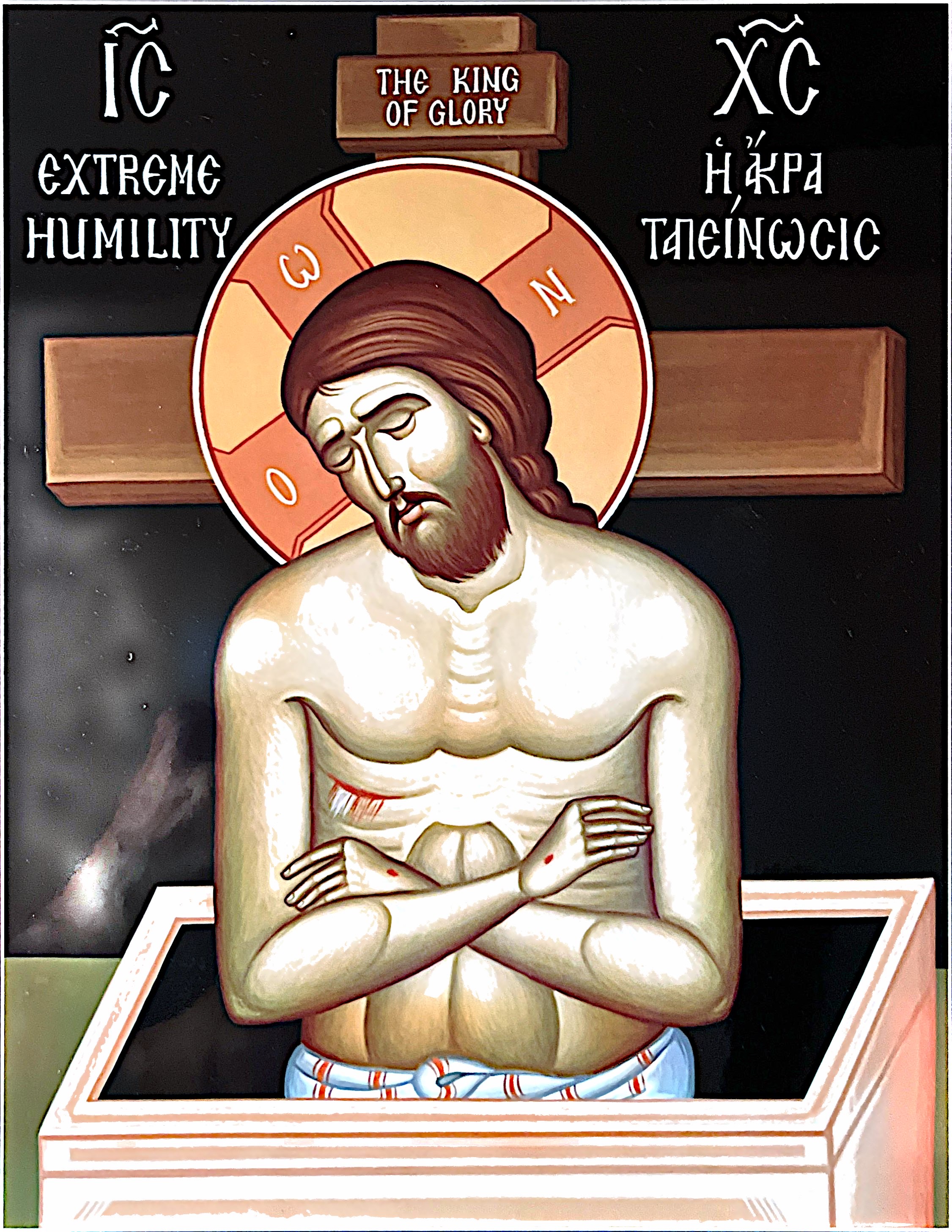
To the right is this same biblical story in the form of an icon called Extreme Humility.  Giving me freedom is not an act of uncaring on God; rather, it is the act of God who loves me more than I love myself. And my freedom from the captivity of sin—my healing—this is Jesus’ kiss on my lips…and is far more “valuable” to me than an answered question.

When I struggle with my question, when the storm clouds return and the winds of evil howl around me as they often do, I return to this icon and remember his kiss.  It is the bedrock upon which my trust in God is built.

Jesus said:
Therefore whoever hears these sayings of Mine, and does them, I will liken him to a wise man who built his house on the bedrock:and the rain descended, the floods came, and the winds blew and beat on that house; and it did not fall, for it was founded on the rock.  But everyone who hears these sayings of Mine, and does not do them, will be like a foolish man who built his house on the sand:and the rain descended, the floods came, and the winds blew and beat on that house; and it fell. And great was its fall.”
–Matthew 7:24-27.


1 The Roots of Christian Mysticism.  Olivier Clement.
2 Job 40:6-8
3 Ecclesiastes 8:17
4 My Utmost for His Highest.  Oswald Chambers.  Jan 2.
5 Spiritual Direction: Wisdom for the Long Walk of Faith.  Henri Nouwen.
6 John 6:32-66
7 John 6:67-69
8 Deuteronomy 30:15-20
9 Luke 4:18
I Can Only Imagine

27 Tuesday Dec 2022

Posted by CurateMike in All, Journey, Self, Trust, Uncategorized

≈ 1 Comment

Tags

Father, Gift, God, Holy spirit, hope, Jesus, Love, Pain, Sacrifice, Son, Trinity

I can only imagine
What it will be like
When I walk by Your side
I can only imagine
What my eyes would see
When Your face is before me
I can only imagine

Surrounded  by Your glory
What will my heart feel?
Will I dance for You Jesus
Or in awe of You be still?
Will I stand in Your presence
Or to my knees, will I fall?
Will I sing hallelujah?
Will I be able to speak at all?
I can only imagine
I can only imagine
“I Can Only Imagine,” Mercy Me

If you’ve listened to Christian radio since 2002 you have undoubtably heard this song, “I Can Only Imagine,” by Mercy Me. It was the most popular Christian song played in 2002 and even cracked the mainstream chart Top 100 in 2003. As a matter is full disclosure, I have seen the band twice, and each time they have performed this song. It is a great song.

For all humans, it captures our deepest longing, as Augustine famously said, “Our hearts are restless until it rests with [God].” For the Christian, the lyric is particularly powerful. It provides a magnificent vision of what it will be like when we are finally face-to-face with our greatest love…Jesus. The song’s words express our deepest emotions and longing in a way that most of us cannot formulate.

I’d like to be able to tell you that the imagery certainly captures what I hope to experience: the overwhelming relief of a good finish to my life, a race well run, a battle well fought, along with the overwhelming sense of wonder and worship at finally being in the presence of ineffable glory of Jesus Himself. To finally find true rest in God free from the weariness of this world.

I’d like to be able to tell you that…but I can’t.

The Divine Liturgy celebrated in the Orthodox church (“Eastern Orthodox”) has been an enigma to my western, enlightened mind. A mystery would be a better description…and a “mystery” in the truest sense. From the opening words of the Liturgy, “Blessed is the Kingdom of the Father and of the Son and of the Holy Spirit now and forever unto ages of ages” to the final “Amen,” the Church has always assumed that during the Divine Liturgy the worshippers are actually(!) in the Kingdom that is both at hand and is to come, the place where all time exists in the present moment: Christ, the lamb slain before creation; the promise to Abraham; the Passover meal, the Last Supper, and the final Wedding Banquet; the giving of the Law to Moses; the birth, death, resurrection, and second coming of Jesus…all moments present in the moment. Further, in the Kingdom, where every knee now bows, we are worshipping God with all those who were, are, and will yet be, and with the tens of thousands of angelic beings. During the Liturgy we are in the very presence of the Most Holy Trinity, which means Jesus is also there, and Jesus is most literally fully present in bodily form in the transfigured bread and wine.

Honestly, though, during the Liturgy it is usually hard for me to feel like I am actually in the Kingdom and in the presence God, but it is not about “feeling” a particular way; rather it is about my faith, believing it to be true.

I can only image…Given this mystery of the Divine Liturgy, I don’t have to image what it will be like in God’s presence as though it is some future event. I can dare say I am in His presence during every Liturgy. And the body and blood of Jesus literally become part of me as I ingest Him from the Eucharist chalice. However, for me, being in Jesus’ presence it bears no resemblance to the song, above. Often, my feet and back ache from standing and I’m quite distracted by kids or others moving about or by my own mind wandering to the events of yesterday and tomorrow.

In those moments when I am able to tame the distractions, I do become aware of the Kingdom and I am overcome by the words of the Liturgy: “It is meet and right to hymn Thee, to bless Thee, to praise Thee, to give thanks unto Thee, and to worship Thee in every place of Thy dominion; for Thou art God ineffable, inconceivable, invisible, incomprehensible, ever-existing, and eternally the same…”

And then I am immediately aware how far I am from God in my expression of love for Him and my neighbor. Sometimes I do have the urge to fall to my knees, as the song imagines, but it is in repentance for my failure to be able to love Him and you, dear reader, as He loves both of us.

Such is being in the actual presence of the consuming fire that is God.

Being in the presence of God brings me pain and shame from my Pride, Anger, Lust, Envy, Gluttony, Avarice, Slothfulness…each of these is at work within me to lead me away from Life Himself. I feel the shame. And, I experience the pain of His all-consuming fire that is His love for me as the Spirit slowly, so slowly, works in me to burn away the goat in my heart. I pray there will be found some sheep in me and that I will be saved through the His loving fire.

Being in the presence of God brings me fear. I too often believe the words of the serpent telling me that I can’t trust God. I want retain control of just enough of my own life so I can salvage it in the event I find I can’t really trust God. I’m like the character in the C.S. Lewis novel, The Great Divorce, who has a lizard-parasite on his shoulder. He is afraid for it to be removed; he doesn’t believe he will become truly himself without it. Like him, I’m comfortable with my demons; removing them is to give up control, to move toward the unknown—in trusting faith. I pray I would have the faith of Christ and come to fully trust God.

Despite the pain, shame, and fear I experience in His presence, I can’t seem to stop walking deeper into His fire. Where else would I go? Jesus has the words of eternal life. His refining fire draws me like a moth. What God most wants from me is no more than He has already offered to me: Himself. He has first offered me a gift that cost Him the death of His Son; it is His gift to me of immeasurable cost and value. What He wants from me is a gift of similar value: all of me. But God’s refining fire still burns me—this is the suffering of becoming one with God. Yet God doesn’t want my fear and pain and shame; He is not a wrathful God. Rather, me bearing my fear, shame, and pain is the cost I to me to give the gift of myself to Him. And when I can no longer bear it, God offers me rest along the way.

While there have been many article written and movies made that focus on Jesus’ agony of His scourging and subsequent death on the cross, the biblical writers actually have little to say about it. Rather, they focus on God’s gift to us in the person of Jesus and the joy of Christ as He faced the cross…His gift to us. This should inform how we think of sacrificial gift-giving.

Rather than me focusing on my suffering, my pain, my shame, and my fear, I should focus on the gift I want to give God—the all-of-me-I-am-able-to-give gift. It is by focusing on the gift and not the cost where we find the peace and joy of Christ. This, after all, is His promise: “Come to Me and I will give you rest.” There is no need to imagine. We can experience it now.

Love and Trust

14 Friday Jan 2022

Posted by CurateMike in Journey, Trust

≈ 2 Comments

Tags

Control, Father, God, Holy spirit, Love, Son, suffering, Trust

A number of years ago, my wife and I had cause to be at an orphanage in Kenya, just outside of Nairobi.  While there, we had become friends with the pastor of the local Anglican church, and, being a Protestant pastor myself at the time, he asked me to deliver the sermon at the upcoming Sunday service.

Oh my.

A number of years ago, my wife and I had cause to be at an orphanage in Kenya, just outside of Nairobi.  While there, we had become friends with the pastor of the local Anglican church, and, being a Protestant pastor myself at the time, he asked me to deliver the sermon at the upcoming Sunday service.

Oh my.

At my home church, I knew the people and their struggles.  I knew the culture of our country and our local community.  Because of that comfort with my “audience,” it seemed easier to believe that the Holy Spirit would speak through me whenever I delivered a sermon.  To deliver a sermon to an unfamiliar church in an unfamiliar culture is daunting.  Sure, fundamentally we are all humans with the same basic problems and hopes.  My greatest worry was to come across as an out of touch or arrogant American.  “What could I say to them?” I wondered.  

The Kenyans I knew believed that America was a Christian country (“It’s on your money!”) and wanted desperately to imitate us.  They watched our TV reruns.  They were a materially poor people and wanted the opportunities available to the average American.  They seemed eager to hear from me.

After a lot of prayer and contemplation, and a few restless nights, that Sunday I did the only thing I knew to do: I asked them to pray for us in America.

Our experience in this small village was of a people that moved more slowly and more in concert with the rhythm of nature.  Few people had cars or even electricity.  When night fell, it was time for bed.  When the sun arose, it was time to get up.  They were far more relational as a village. My pastor friend used to introduce me by saying, “This is my friend; we walk together.”  We walk together…what a remarkable phrase to describe a relationship.

From the locals we heard a few stories of people being raised from the dead in answer to prayer.  There were other stories of remarkable healings.  I watched the repeated “miracle” of Samuel who each day picked a bunch of bananas, walked a few miles to the market, sold them for just enough to buy what he needed for that day.  Not all of our Kenyan friends prayers were answered, but they continued on in life, relying on God for what they needed.  It was like watching the Psalms played out in real life: sometimes joy, sometimes wailing, sometimes pleading…but always in relationship with God.  It seemed like their lives said about God, “This is my God; we walk together.”

So, in my sermon I asked the Kenyans to pray for us.

I remember saying to them that in our American abundance, we have come to believe that we didn’t really need God.  The words, “Give us this day our daily bread,” are often just that, words.  After all, my refrigerator is full and so are the grocery store shelves.  Through my hard work or government programs, I have access to the necessities of food, healthcare, transportation, and housing.  A great many of us Americans spend lavishly, at least by our Kenyan friends’ standards, on travel, entertainment, clothes, hobbies, etc.Rarely do we (me, most of all) in America have to really trust God for our very survival.  I told them we needed their prayers to realize just how much we are reliant on God—for everything, actually.  And pray that once we realize that, we learn to actually trust Him to provide what we need each day (again, me, most of all).  Then we returned to America and over the course of a few months I had returned to my American lifestyle.

Fast forward to last year.  We had a major deep freeze for which the state-wide utility system was woefully unprepared.  Many thousands lost power and water.  Nearly three hundred died from hypothermia.  Afterward, when life was returning to normal, I heard someone comment that they had been blessed by God because they had not lost power during the storm.  We had been similarly “blessed”; however, the word troubled me.  I noticed that I didn’t hear anyone who lost power say they were blessed by God.  I thought of my Kenyan friends and I wondered whether had we lost power and water I would have been able to say, and mean, “We were blessed by God.”

I used to say easily, too easily, that I love and trust God.  I had the fearlessness of youth.  Now that I am older, I have seen and experienced much more of the suffering of life.  Why is it this way?  It is a question that still haunts me.  I remain convinced that I love God, but I have begun to examine whether I really trust Him.

God created humankind to be in relationship with Him, to share in His life.  Jesus tells us that eternal life is to know God (not just know about Him), to have the deepest sort of relationship with God that is possible between two beings. (John 17:3)

It is my sinfulness that separates me from God.  Thankfully, the Church provides me with tools to help me battle the sins that separate me from experiencing a fuller relationship with God.  Prayer, fasting and giving are the classic three methods of ascesis, the self-disciplined “training” to help me control and overcome the broken passions that run amok in my life.  And in my effort, God (the Holy Spirit) is with me helping in each step.  However, as necessary as these are, they are voluntary forms of ascesis.  In other words, I can control them: sometimes I do them and other times not.

Trust in God, real trust, begins when I turn my life over to Him, when I let go of all control.  I is actually nothing but accepting the real reality: that little of my life is under my control.  But it is more: real trust begins when I can believe that everything in my life—especially those things outside of my control like loss of power and water during a dangerous ice storm—offers the opportunity for healing my broken passions and drawing me closer to God.  Can I actually trust God like that?

I came across this quote the other day from a Christian Orthodox monk.  I find it sobering:

Are we patient during…trials and difficulties? Do we consider these things necessary on account of our sins? This is referred to as involuntary ascesis. We can say to God, “My God, I didn’t do any voluntary ascesis; however, I patiently endured the involuntary ascesis that You sent me in Your wisdom. I was ill, I became widowed, I was ridiculed, I was wronged, and I endured everything for Your love.” Then Christ will respond, “Very well. What did I do for you? Look at My hands and feet: they have holes. Look at My side: it is pierced. Look at My head: it is full of blood from the thorns. Look at My forehead: it is covered in sweat. Look at My back: it is full of scourges and lashes. My entire body and soul suffered for you. I also accept what you did for Me.”
—Elder Ephraim. The Art of Salvation. Saint Nektarios Greek Orthodox Monastery. Kindle Edition. Location 2589.

Involuntary ascesis, I had never thought of the “trials and difficulties” of life in quite this way.  Does God really love me so much that everything in my life—everything, both joyful and sorrowful—comes from Him, directly or indirectly, with the sole potential of healing me and drawing me to Him?

And not just for me, but for all of us?  Does God so love the world that everything that happens in the world is a manifestation of His love for us and is an invitation to healing and relationship with God  Death entering the world through Adam and Eve; God kicking them out of the Garden; the plagues upon Egypt; the beauty of a sunset; the wonder of a bird singing; the death of thousands from a tsunami; Jesus’ birth death, and resurrection; the COVID pandemic; the love of another person, the magnificence of music, literature, and art; the death of a beloved neighbor, the smell of a flower, the suffering of a child, the trumpets and bowls of the end times…everything, everything, EVERYTHING!!

Can I trust in Him in His love for me and all of us without knowing why He created this world, this reality, with the beauty and the pain and the suffering as He has?

If I answer, “Yes,” then my joy and suffering has meaning in this world.  It is all redeemed by God as I heal and draw deeper into relationship with Him.  If I answer, “No,” then for me the suffering becomes meaningless and I slowly lose myself in fear, anger, and despair, living a life seeking both control and distraction from reality.

It is our choice, yours and mine, to walk with God in complete trust.  It is a choice to be made every moment of every day of our lives.

It is not easy.

Love God with all of your heart, soul, mind and strength…
—Luke 10:27

AND

Trust in the Lord with all your heart,
And lean not on your own understanding;
In all your ways acknowledge Him, And He shall direct your paths.

—Proverbs 3:5-6

The Glory of God and Abraham Maslow

07 Monday Oct 2013

Posted by CurateMike in All, Trust

≈ 3 Comments

Tags

Christianity, Divine Dance, Elijah, God, Maslow, perichoresis, Trinity

God then told Elijah, “Get out of here, and fast. Head east and hide out at the Kerith Ravine on the other side of the Jordan River. You can drink fresh water from the brook; I’ve ordered the ravens to feed you.”  Elijah obeyed God’s orders. He went and camped in the Kerith canyon on the other side of the Jordan. And sure enough, ravens brought him his meals, both breakfast and supper, and he drank from the brook.

Biblical book, 1Kings, ch 17, verses 2-6

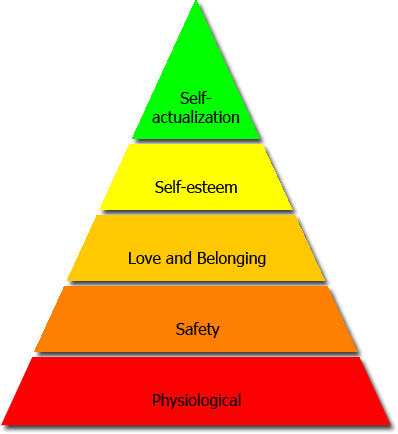
In 1943, American psychologist Abraham Maslow published a work asserting that humans are motivated by an ascending set of needs.  It is sometimes represented by a triangle with our most basic needs, our physiological needs, at the bottom and moving up towards our highest need, self-actualization.

maslow-need-hierarchy

While I doubt that the complexity of human behavior and motivation can be boiled down to a few simple categories, my own recent experience of needing has gotten me thinking about trusting God with respect to Maslow’s hierarchy of needs.

Then, in my mind I contrasted my degree of trust in God at Level 5 with my imagined trust at Level 1, physiological needs.  Trusting in God for my next bite of food or drink of water seemed in my imagination to require a deeper, more radical kind of trust than that at Level 5.  Certainly achieving some level of self-actualization is not as life-or-death as one’s need for food and water.  Could God really be trusted at this level?

I first began wondering whether the strength of my trust in God was somehow related to the stage of need in my life as represented by Maslow.  For example, if I felt the four lower needs were met and I was striving for Level 5, self-actualization, I might find it easy–casual might be a better word–to trust God.  As I cried out to him to become who He created me to be, I could console myself in the fact that He is indeed at work in me, but that becoming my true self is at least a lifelong journey.  I found could relax a bit because the lower needs were met.

For the glory of God is a living man; and the life of man consists of beholding God.

Then a very old saint, Irenaeus, came to mind.  “For the glory of God is a living man; and the life of man consists of beholding God,” he said nearly nineteen centuries ago (Against Heresies, 4.20.7).  Then in my mind the pyramid representing Maslow flipped on its head and disintegrated.  I exist because God wanted to share with me His loving life within the Trinitarian community–the magnificent relationship between Father, Son, and Holy Spirit.  Regaining unity with the Christian God is the recognized goal of one’s life with God and, in that, God is glorified as we become who we are created to be: His children who behold Him and join in loving relationship with Him.

For the maturing Christian, the needs of physiology, safety, socializing, and esteem increasingly take a back seat to actualization.  However, it is not Maslow’s self-actualization in the sense of a self-help project I undertake for myself.  It is quite the contrary.  The journey toward actualization–to being reunited with God–”is not a question of merits but of co-operation, of a synergy of two wills, divine and human” (Lossky, The Mystical Theology of the Eastern Church).  I join in with what God is doing in me.

Here is where the life of a Christian becomes so contrary to what we grasp by our senses and what we know in our minds: that we must take care of, or someone must provide for first our basic needs and then our subsequent needs for us finally to be happy and fulfilled.  No.

The Christian life is my turning “towards God of [my] own free will and with all [my] longing” (Lossky).  Early on I learn to pray for my basic needs–”Give me this day my daily bread”–but as I mature with God my needs change from things to a singular longing for Him.  My faith becomes that of gazing at Him and my trust in Him becomes ruthless.  “Little by little the soul reintegrates itself, regains its unity, and particular petitions begin to disappear making them superfluous, as God answers prayer by making manifest His all-embracing providence.  There is an end to petition when the soul entrusts itself wholly to the will of God.” (Lossky).

God knows and provides for all of our needs in His way and His timing as He draws us toward Him; we gaze upon His face as we seek to follow His leading–it is the Divine Dance.  This is the state of a person truly alive, and persons on this journey bring glory God.  It is a state in which even the “great saints” of human history moved in and out of; after all, our deification, being united in relationship with God, is a very, very long journey.

So, get on the dance floor with God; its okay if you step on His toes as you learn the steps and rhythm of the dance and to follow His lead.

Enter your email address to follow this blog and receive notifications of new posts by email.

Join 87 other subscribers

Recent Posts

  • Bedrock
  • Healing by Fire
  • I Can Only Imagine
  • Defending Myself
  • A Lesson From Leroy

Categories

Archives

Blogs I Follow

  • O'Byrne Report
  • Spirituality and Nature

Credits

  • Desert Photo

Create a free website or blog at WordPress.com.

Privacy & Cookies: This site uses cookies. By continuing to use this website, you agree to their use.
To find out more, including how to control cookies, see here: Cookie Policy
  • Subscribe Subscribed
    • curacy
    • Join 87 other subscribers
    • Already have a WordPress.com account? Log in now.
    • curacy
    • Subscribe Subscribed
    • Sign up
    • Log in
    • Report this content
    • View site in Reader
    • Manage subscriptions
    • Collapse this bar
 

Loading Comments...