
• About Curate Mike
  • Wandering Wonderings

curacy

~ thoughts from the desert

curacy

Tag Archives: Divine Dance

Image and Likeness

08 Monday Sep 2014

Posted by CurateMike in All, Humankind

≈ 1 Comment

Tags

Divine Dance, God, Holy spirit, image of God, Jesus, likeness of God, Theosis

Then God said, “Let Us make man in Our image, according to Our likeness…”
From the story of creation, Genesis 1:26

I’m sitting in a small beach house on the Gulf of Mexico and calling it work. Really, I am working…you will have to trust me on that. It is just that right now the work involves waiting on a client.

While I’m waiting I have these few minutes to enjoy God’s creation and to ponder what it means that we are made in God’s image and likeness.

Some biblical commentators have suggested that image and likeness are the same, that the writer of Genesis says the same thing twice and in two different ways to make the strong point of our value as humans.

I recently came across another explanation that I find more theologically satisfying.

“In the beginning…” as the Book says, God and the first humans were united; humankind was by Grace what God is by nature. All was “good” until our first parents fell for a lie. The consequence of their disobedience of God changed humanity; our respective natures, God’s and man’s, were no longer united. Without God’s Spirit within us we became bound to the dust out of which we were created rather than bound to our Creator. To speak like the late Carl Sagan, we became the stuff of the creation rather than the stuff of the Creator.

God’s words from Genesis 3:16–

For dust you are, and to dust you shall return.

Our union with God now broken, there was no way for us to remain in the Garden of Eden, the garden of perfect harmony with our Creator. We had to leave. It remained that way for us for untold years, and, left to our own devices, there was no way to return, no way to reunite human nature with Divine nature. Separation of our nature from God’s, and being nothing but dust, would have been our eternal fate had God chosen not to act on our behalf.

At the moment of our separation from Him he announced that He had a plan for our restoration to Him, a plan to rescue us from being bound to the dust which is the world. Then one day, over two thousand years ago, Jesus was born and God’s rescue operation was made evident in the person of a baby.

One of the central beliefs of Christianity is that Jesus was both God and man, both human and Divine. I think we so often focus on Jesus’ death that we forget the significance of His birth. At the moment of His conception and manifest in His birth, human nature and Divine nature were reunited. Jesus became, as the Bible tells us, the second Adam. This has the most profound implication for us! Because of His birth it became possible for each of us to be reunited with God. With the birth of Jesus, the potential now existed for us to return home.

This potential is how the early Church Fathers came to understand our being made in the “image” of God: it is the potential for our “sanctification,” for our two natures, God’s and ours, to be united (called Theosis). And it is this potential that gives us value as humans over any other living thing: we are created in the image of God. Each of us humans has the potential to have our individual nature united with God’s nature. There are some who would try to confer “personhood” on apes or dolphins or other creatures based on intelligence, language use, etc.; however, no other creature has the potential to be united with God; humans alone are created in the image of God.

With this understanding of “image,” here is a great quote from the late Archbishop Dimitri of Dallas I want to throw in at this point:

The greatest danger in the modern world is the attack on man as the image of God. That God became man in order to unite man to God is the only sure Divine underwriting of human worth. We have value because of the image we bear.

If this potential of united natures is “image of God,” then what is “likeness?” It is simple, really. If “image” is the potential of union with God, then “likeness” is the actualization of that union. To actualize the potential, we must do two things. First, we must give God permission to begin drawing us into His life.

There are a lot of fancy theological words bandied about regarding Christianity. The bottom line is that God wants to invite us into His life, an unimaginable life of unconditional love. The ancients characterized this communal life of God the Father, God the Son (Jesus), and God the Holy Spirit, as a Divine Dance (perichoresis). God draws us into His life and wants desperately to teach us the steps of the dance.

This, then, is the second thing we must do: we must learn to cooperate with Him as He teaches us how to live life with Him, to dance the Divine Dance. And He is a gracious and patient dance instructor.

The most remarkable thing is that God wants this for each of us. After all, it is God’s desire that no one should spend an eternity dancing alone, disunited from Him. However, not everyone wants that sort of union with God.

So, look around you. Every human being you see bears the image of God. From the most kind person to the most hated terrorist, every one of us is an icon, an image of the living God. Every human being has inestimable value to God. Imagine a world in which we treated each other that way. Better yet, imagine a world in which this potential is fully realized. One day we won’t have to imagine this actualized world…it is God’s promised kingdom come. I pray that by God’s Grace within me, I will see you there.
The Cell

12 Thursday Dec 2013

Posted by CurateMike in All, Life

≈ 2 Comments

Tags

cell, desert fathers, desert mothers, Divine Dance, Jesus, monastic, monk, Trinity

In Scetis, a brother went to see Abba Moses to ask for advice. The old man said, “Go and sit in your cell and your cell will teach you everything.”

Nearly 1700 years ago the small vanguard of what would grow to more than 100,000 people left civilization and moved into the deserts of Egypt and Syria.  They were the first monks (from the Greek, meaning “single” or “alone”); we know them today as the Desert Mothers and Fathers.

When Emperor Constantine made Christianity the state religion the Roman persecution of Christians ceased.  Being a Christian became easy, even fashionable, so much so that these Christian women and men left for the hard living of the desert.

These early monks lived in caves or small dwellings, known as cells. They lived radically isolated and simple lives practicing a disciplined (ascetic) life that we would consider quite extreme by today’s standards.  Yet, their lives were attractive to many—even then people would travel great distances for a word of wisdom from these monks.

This kind of simple life can be attractive to us, particularly in our frenetic world.  We long for the slower pace.  But I’m not talking about seeking after a simple life for the sake of escaping the pace of the world.  What drove these women and men into the deserts was not their desire to escape society and live simply; rather, it was their desire to directly confront the root cause of all battles…ourselves…and this was their chosen battlefield.

You see, must have been from a the cell that Pogo’s creator finally met the enemy and discovered he was us.  It was from his literal prison cell that Solzhenitsyn came to understand that the line separating good from evil does not run between countries or classes of people or political parties but through the heart of each of us.

But to enter one’s cell without the Christian God is to join the path of a downward spiral to the nothingness of Sarte’s existentialism, the place of ultimate hopelessness.  By contrast, the great hopefulness contained within the writings of these early monks remains with as much veracity today as it had 1700 years ago.

Here is something I have learned: you do not have to become a monk living in the desert or a monastery to experience life in a monastic cell.  Life in a cell can be had in the desert or in the midst of a bustling, modern city.  There is a cell awaiting each of us if we would only seek it.

The path to eternal life is difficult.  The gate of entry is narrow and the path is hard.  I am coming to believe that eventually, in this world or the next, each of us must learn what our cell has to teach us; more correctly, to allow God to shape us into the image of His Son, Jesus, who is leading us into life with the Trinity: Father, Son, and Spirit.  There is no other path.

Perhaps you know of such a person, a monk-in-the-world; they can be recognized as ones who strive to live with God at a different pace and with a different set of priorities.  You might even envy their life.  Be careful of what you wish.

What is a cell?

A cell is more a state of being than a geographical place.  When we decide to respond to Jesus’ invitation to seek our true selves in Him we move into our cell.  But what does this really mean?  It means that we begin to learn to stop hiding from God in fear.  We begin learning to step out from behind the things that we believe define us or we let distract us; things, such as job titles, street addresses, school names on our diplomas, emails, the number of zeros on our paychecks, prior accomplishments, the shape of our bodies, names on the labels on our clothes, task lists, immersion in the lives of favorite celebrities, constant music, TV shows, 401(k)s, cell phones, texting, number of Facebook friends…these things and more feed our false identity and distract us with their allure.

What awaits us in our cell?

In our cell there are several beings present.  We often think of the monk living a solitary life.  This is not so.  God (the persons of the Father, Son, and Spirit) and the Devil and his minions are in our cell with us.

In our cell we discover that the battle takes place within the very being of the ourselves with God encouraging, beckoning, and strengthening and Satan taunting, accusing, and attacking.

In our cell we discover that in each moment we face a choice, “With whom will I side in the battle?”

In our cell we learn that we can choose poorly and there are consequences.

In our cell we ask the most profound questions of life.  Questions such as, Who am I?  What does it mean to be human?  What lies beyond this life?  From where does my worth come?  How do I really measure a successful and productive life?  In what (or whom) do I actually trust?  Where do I find hope for today?  What will tomorrow bring?  How do I know whether this path is the right path?   Am I really loved by God?  How much longer?

In our cell the lies we have believed all of our lives are gradually exposed.

In our cell we revisit the precipitating events for our deepest wounds.

In our cell we confront head-on temptation from the eight deadly thoughts that torment us: gluttony, lust, covetousness, anger, dejection, acedia, vainglory, and pride.

In our cell we experience physical, emotional, and spiritual hardship.

In our cell we learn that no woman or man can survive their cell without the presence of God; we are simply unable to withstand the company of our sinful selves on our own.

What does our cell teach us?

In our cell we learn to distinguish between the voices of God and Satan.

In our cell we learn how to choose God, and when we choose poorly we find God who is always calling to us, helping us, and urging us to turn back toward Him.

In our cell one by one the questions we had begin to dissolve as we draw closer to God Himself.  We ask. He answers, “I AM.”  Mysteriously, that answer begins to satisfy us.

In our cell we gradually begin to learn that Truth is a Person and not a set of rules.

In our cell we come to understand what it really means that by His wounds we are healed.

In our cells we find new memories of our past traumas in which Jesus was indeed present though we knew it not at the time.

In our cells we learn disciplines that help us cooperate with God as He gradually digs out the roots of all temptations and our heart of stone is gradually replaced by God’s heart of flesh.

In our cell we learn that mysteriously through the work of the Holy Spirit our perseverance in the trials changes our character, and we find real hope.

In our cell we learn that we are God’s beloved son or daughter in whom He is well pleased and we begin to hear Him singing over us.

The real beauty of the cell

Each of the lessons from our cell is the Holy Spirit’s way of teaching us a new step of the Divine dance with the Trinity.  As we are able to grow in our confidence in our ability to move with God to the rhythms of His grace we begin cooperate with God and allow Him to work in us, gradually we are stripped of all that we have learned to hide behind and we will once again stand before God, clothed in His righteousness and unafraid.  True self being led gracefully across the dance floor by the Trinity.

The Glory of God and Abraham Maslow

07 Monday Oct 2013

Posted by CurateMike in All, Trust

≈ 3 Comments

Tags

Christianity, Divine Dance, Elijah, God, Maslow, perichoresis, Trinity

God then told Elijah, “Get out of here, and fast. Head east and hide out at the Kerith Ravine on the other side of the Jordan River. You can drink fresh water from the brook; I’ve ordered the ravens to feed you.”  Elijah obeyed God’s orders. He went and camped in the Kerith canyon on the other side of the Jordan. And sure enough, ravens brought him his meals, both breakfast and supper, and he drank from the brook.

Biblical book, 1Kings, ch 17, verses 2-6

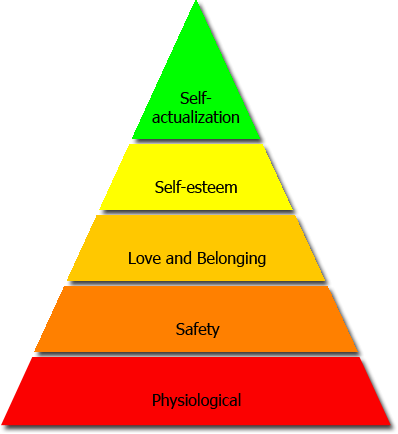
In 1943, American psychologist Abraham Maslow published a work asserting that humans are motivated by an ascending set of needs.  It is sometimes represented by a triangle with our most basic needs, our physiological needs, at the bottom and moving up towards our highest need, self-actualization.

maslow-need-hierarchy

While I doubt that the complexity of human behavior and motivation can be boiled down to a few simple categories, my own recent experience of needing has gotten me thinking about trusting God with respect to Maslow’s hierarchy of needs.

Then, in my mind I contrasted my degree of trust in God at Level 5 with my imagined trust at Level 1, physiological needs.  Trusting in God for my next bite of food or drink of water seemed in my imagination to require a deeper, more radical kind of trust than that at Level 5.  Certainly achieving some level of self-actualization is not as life-or-death as one’s need for food and water.  Could God really be trusted at this level?

I first began wondering whether the strength of my trust in God was somehow related to the stage of need in my life as represented by Maslow.  For example, if I felt the four lower needs were met and I was striving for Level 5, self-actualization, I might find it easy–casual might be a better word–to trust God.  As I cried out to him to become who He created me to be, I could console myself in the fact that He is indeed at work in me, but that becoming my true self is at least a lifelong journey.  I found could relax a bit because the lower needs were met.

For the glory of God is a living man; and the life of man consists of beholding God.

Then a very old saint, Irenaeus, came to mind.  “For the glory of God is a living man; and the life of man consists of beholding God,” he said nearly nineteen centuries ago (Against Heresies, 4.20.7).  Then in my mind the pyramid representing Maslow flipped on its head and disintegrated.  I exist because God wanted to share with me His loving life within the Trinitarian community–the magnificent relationship between Father, Son, and Holy Spirit.  Regaining unity with the Christian God is the recognized goal of one’s life with God and, in that, God is glorified as we become who we are created to be: His children who behold Him and join in loving relationship with Him.

For the maturing Christian, the needs of physiology, safety, socializing, and esteem increasingly take a back seat to actualization.  However, it is not Maslow’s self-actualization in the sense of a self-help project I undertake for myself.  It is quite the contrary.  The journey toward actualization–to being reunited with God–”is not a question of merits but of co-operation, of a synergy of two wills, divine and human” (Lossky, The Mystical Theology of the Eastern Church).  I join in with what God is doing in me.

Here is where the life of a Christian becomes so contrary to what we grasp by our senses and what we know in our minds: that we must take care of, or someone must provide for first our basic needs and then our subsequent needs for us finally to be happy and fulfilled.  No.

The Christian life is my turning “towards God of [my] own free will and with all [my] longing” (Lossky).  Early on I learn to pray for my basic needs–”Give me this day my daily bread”–but as I mature with God my needs change from things to a singular longing for Him.  My faith becomes that of gazing at Him and my trust in Him becomes ruthless.  “Little by little the soul reintegrates itself, regains its unity, and particular petitions begin to disappear making them superfluous, as God answers prayer by making manifest His all-embracing providence.  There is an end to petition when the soul entrusts itself wholly to the will of God.” (Lossky).

God knows and provides for all of our needs in His way and His timing as He draws us toward Him; we gaze upon His face as we seek to follow His leading–it is the Divine Dance.  This is the state of a person truly alive, and persons on this journey bring glory God.  It is a state in which even the “great saints” of human history moved in and out of; after all, our deification, being united in relationship with God, is a very, very long journey.

So, get on the dance floor with God; its okay if you step on His toes as you learn the steps and rhythm of the dance and to follow His lead.

Enter your email address to follow this blog and receive notifications of new posts by email.

Join 87 other subscribers

Recent Posts

  • Bedrock
  • Healing by Fire
  • I Can Only Imagine
  • Defending Myself
  • A Lesson From Leroy

Categories

Archives

Blogs I Follow

  • O'Byrne Report
  • Spirituality and Nature

Credits

  • Desert Photo

Create a free website or blog at WordPress.com.

Privacy & Cookies: This site uses cookies. By continuing to use this website, you agree to their use.
To find out more, including how to control cookies, see here: Cookie Policy
  • Subscribe Subscribed
    • curacy
    • Join 87 other subscribers
    • Already have a WordPress.com account? Log in now.
    • curacy
    • Subscribe Subscribed
    • Sign up
    • Log in
    • Report this content
    • View site in Reader
    • Manage subscriptions
    • Collapse this bar
 

Loading Comments...